Gullu
When Do Kids Start Drawing People, Faces and Shapes? Drawing Stages by Age
Short answer: Most children draw a circle by age 3 when shown how and a person with three or more body parts by age 4, according to CDC milestones. Zero to Three places first pictures of people between about 3 and 5 years. Early people are often a circle with a face and legs, and that is expected.
What are the stages of drawing by age?
Zero to Three describes five overlapping stages, from random scribbling at about 15 months to letter and word practice at 3 to 5 years. It notes the timetables are approximate and that a child may move faster or slower and still be developing just fine (Zero to Three).
| Stage (Zero to Three) | Approximate age | What you see on the page |
|---|---|---|
| Random scribbling | 15 months to 2½ years | Marks from big shoulder movements, crayon in a fist |
| Controlled scribbling | 2 to 3 years | Repeated open circles and straight, curved or diagonal lines |
| Lines and patterns | 2½ to 3½ years | Lines, dots and curves that look like bits of letters; the child may tell you what it says |
| Pictures of objects or people | 3 to 5 years | Pictures named after they are finished, then planned ahead; first pictures often build off circles |
| Letter and word practice | 3 to 5 years | Letters from the child's own name, pretend letters, short and long "words" |
CDC milestones mark a few fixed points along the way: scribbles by 18 months, a circle by 3 years, and a person with three or more body parts by 4 years. Our coloring milestones guide covers the coloring side of the same years.
What age can a child draw a circle?
By age 3, for most children. The CDC lists drawing a circle, when you show the child how, as a 3-year milestone (CDC). The American Academy of Pediatrics also says a 3-year-old can copy a circle and trace a square (AAP).
Rough, open circles appear earlier, during controlled scribbling at about 2 to 3 years (Zero to Three). The closed circle matters because so much is built from it: a sun, a face, a wheel. Other shapes come later. The AAP places tracing and copying patterns such as stars or diamonds at ages 4 to 5. Our shapes coloring pages give children bold circles, squares and triangles to color and talk about.
When do kids draw faces and people?
Between about 3 and 5. Zero to Three places pictures of objects or people at 3 to 5 years and says a first person is usually a circle with roughly recognizable human features (Zero to Three). By 4, most children draw a person with three or more body parts (CDC).
The AAP adds detail for ages 4 to 5: children now decide what they want to draw before they start, and their people have eyes, a nose and a mouth (AAP). So the usual order is circle, then face, then a few body parts, then more detail.
"Three or more body parts" is a low bar on purpose. A head, two eyes and a line for a leg can count. A 3-year-old who is not drawing people yet is within the range Zero to Three describes.
Why do first people have legs growing from the head?
Because that is how early people usually look. The AAP says a 4-year-old's figures may have no body at all, with legs "sticking out of the head," and that to the child the drawing is still a person (AAP). Parents often call these tadpole or potato people.
Zero to Three's description fits the same picture: first drawings build off circles, so the circle that was a sun last month becomes a face with stick arms and legs this month. Once a child draws images on purpose, Zero to Three says, they have grasped that lines on paper can stand for something else, such as a house, a cat or a person. The body between the head and the legs arrives later, as the child adds detail.
There is no need to correct a tadpole person. The child knows people have tummies. The drawing is a symbol, not a portrait.
Should a 2½-year-old be drawing yet?
Scribbling, yes. Recognizable pictures, not yet. At 2½, Zero to Three's stages put a child in controlled scribbling or the start of lines and patterns: repeated circles, lines and dots (Zero to Three). The CDC's drawing milestones are scribbling by 18 months and a circle by 3 years, with no picture expected in between.
Some 2-year-olds do produce a face early, and some announce that a scribble is a dog. Zero to Three describes that naming of unplanned creations as the first step toward pictures. The AAP says 2-year-olds become interested in drawing, and that a box of crayons or finger paints is enough to get their creativity going (AAP). Paper, crayons and time are enough.
How can I encourage drawing without taking over?
Comment on the process and let the child lead. Zero to Three suggests describing what you see, such as how many lines the child is making, or simply asking them to tell you about the picture, instead of quizzing them or insisting that trees be green (Zero to Three).
A few practical ideas:
- Keep supplies in reach. The CDC suggests an activity box with paper, crayons and coloring books for 3-year-olds (CDC).
- Draw next to them, not for them. Make your own picture and let them watch how you start.
- Write down their words. If they tell you what the picture is, write it at the bottom.
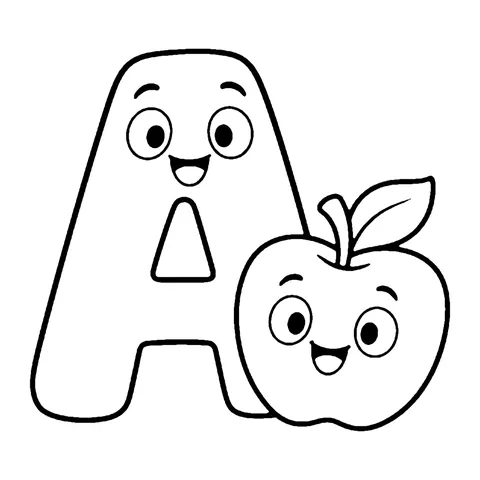
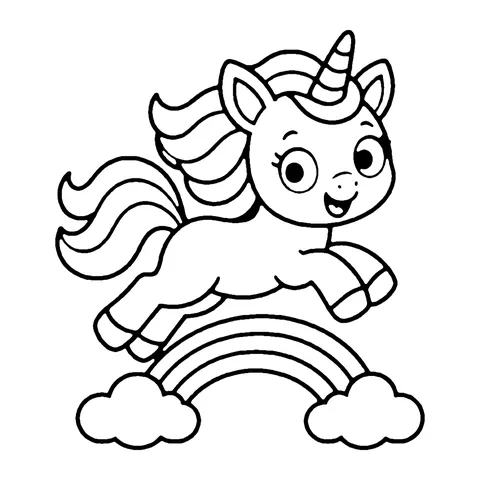
- Mix blank paper with coloring pages. A bold, easy page shows how a picture is built from simple shapes; a blank sheet lets them try it. Pages picked for 3-year-olds keep shapes large.
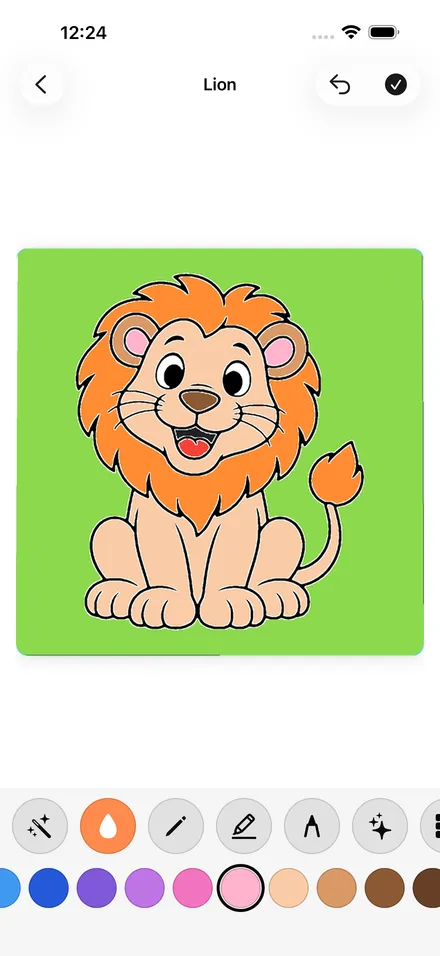
On a screen, look for a blank canvas as well as pages to fill in. Gullu, our coloring app for iPhone, iPad and Mac, includes free drawing on a blank sheet.
When should I ask a doctor?
Ask whenever you are worried. The CDC's advice is that if your child is not meeting one or more milestones, or has lost skills they once had, you should talk with your child's doctor, share your concerns and ask about developmental screening (CDC).
For drawing, the CDC milestones to know are scribbling by 18 months, a circle (when shown how) by 3 years, and a person with three or more body parts by 4 years. Missing one is a reason for a conversation, not a diagnosis. Children develop at their own pace, and a doctor can look at the whole picture.
FAQ
Can a 3-year-old draw a person?
Some can. Zero to Three places first pictures of people between 3 and 5 years, and the CDC milestone for a person with three or more body parts is age 4. A 3-year-old drawing circles and lines is on track.
Is it normal for a 2-year-old to draw faces?
It happens, though it is early. Most 2-year-olds are scribbling and beginning to make circles. A face at 2 is a pleasant surprise, and no face at 2 is entirely typical.
What age do kids draw stick figures?
The sources here do not give an age for stick figures as such. By 4, most children draw a person with three or more body parts, and by 4 to 5 the AAP says their people have eyes, a nose and a mouth.
Why do kids scribble?
Scribbling is how drawing and writing begin. Toddlers discover that moving the crayon makes a mark, and control grows from there. The CDC lists scribbling as a milestone most children reach by 18 months.
Does coloring help with drawing?
Coloring practices crayon control and shows how pictures are made of shapes. See our guide to the benefits of coloring for what the research does and does not show.
Sources
- Zero to Three, "Learning to Write and Draw": https://www.zerotothree.org/resource/learning-to-write-and-draw/
- CDC, "Important Milestones: Your Child By Eighteen Months": https://www.cdc.gov/act-early/milestones/18-months.html
- CDC, "Important Milestones: Your Child By Three Years": https://www.cdc.gov/act-early/milestones/3-years.html
- CDC, "Important Milestones: Your Child By Four Years": https://www.cdc.gov/act-early/milestones/4-years.html
- HealthyChildren.org (AAP), "Hand and Finger Skills of Your Preschooler": https://www.healthychildren.org/English/ages-stages/preschool/Pages/Hand-and-Finger-Skills-of-Your-Preschooler.aspx
- HealthyChildren.org (AAP), "Hand and Finger Skills for 2 Year Olds: Fine Motor Milestones": https://www.healthychildren.org/English/ages-stages/toddler/Pages/Hand-and-Finger-Skills-2-Year-Olds.aspx