Gullu
Benefits of Coloring for Kids — What Coloring Teaches Toddlers and Preschoolers
Short answer: Coloring gives young children steady practice with hand control and crayon grip, a natural way to learn color names, and an easy opening for conversation. The research supports it as one useful part of a varied art diet, not a magic skill builder, so mix coloring pages with free drawing and talk about what your child makes.
Below is what coloring actually practices, what the evidence says (and doesn't say), and how to get the most out of it at home or in class.
What skills does coloring practice?
Hand control and a mature crayon grip
Every time a child steers a crayon toward an edge, they practice the small, precise hand movements that writing will later demand. Grip changes a lot in these years. The CDC lists holding "a crayon or pencil between fingers and thumb (not a fist)" as a 4-year milestone.
A classic occupational therapy study watched 320 typically developing children aged 3 to 6 during a drawing task and a coloring task. The share using a mature grip rose with age, from 48% in the youngest group to 90% in the oldest (Schneck & Henderson, 1990). Coloring is one of the everyday activities where that grip gets its practice.
Visual-motor skills linked to school readiness
In a study of 213 children assessed before kindergarten, scores on a design copy task (copying shapes like a circle or square with a pencil) predicted higher achievement at kindergarten entry and bigger gains during the year (Cameron et al., 2012). That study is correlational and did not test coloring itself, so it doesn't prove coloring raises test scores. It does show that the eye-hand coordination children use when coloring shapes matters for early learning.
Color names and describing words
Naming "a few colors of items" is on the CDC's 4-year milestone list. A coloring page is a natural place to use those words: "Which green do you want for the frog? The dark one or the light one?" Themed pages add vocabulary too, from tractor and barn on farm animal pages to triceratops on dinosaur pages.
A bridge to early writing
Drawing and scribbling come before writing. Zero to Three describes a rough sequence from random scribbling to controlled scribbling, then lines and patterns, then pictures, then letters, and stresses that the timetables are approximate (Zero to Three). Coloring letter shapes on alphabet pages or numerals on number pages gives kids a low-pressure look at the forms they will later write. By age 5, the CDC notes most children write some letters in their name and name some letters.
Planning and finishing a task
Choosing a color, sticking with a section and deciding when a page is "done" are small acts of planning and follow-through. NAEYC points out that more structured, product-focused art has its own value for fine motor and executive function skills, while open-ended "process art" better supports self-expression (NAEYC).
Does coloring help kids calm down?
Possibly, but be careful with big claims. Most of the research on coloring and stress involves adults or older children. In one randomized classroom study of 152 children around age 10, test anxiety fell after the coloring sessions (Carsley & Heath, 2019). We found no comparable trials in toddlers or preschoolers.
What is well supported is simpler. Zero to Three suggests art as an outlet for big feelings. A child in the middle of a meltdown may enjoy drawing "a very angry picture" (Zero to Three). A quiet coloring page can be a good wind-down choice. It isn't a treatment for anxiety.
Do coloring pages limit creativity?
This is a fair worry. Early childhood educators distinguish product-focused art, where children work toward a set result, from process art, where children freely explore materials with little direction (NAEYC). Coloring pages sit on the product side.
The practical answer is balance, not banning:
| Activity | What it mostly builds | How often |
|---|---|---|
| Coloring pages | Hand control, grip, color words, finishing a task | A few times a week |
| Free drawing on blank paper | Imagination, planning, storytelling | As often as they like |
| Process art (paint, collage, clay) | Exploring materials, self-expression | Weekly if you can |
| Tracing and copying shapes | Visual-motor control, pre-writing | Short, playful sessions |
You can also make coloring pages more open-ended. Invite a purple elephant, add a background, or draw what happens next. NAEYC's process-art guidance suggests responding to children's choices rather than steering them toward the "right" colors (NAEYC).
How can parents get more out of coloring time?
- Talk about the picture, not just the neatness. Zero to Three suggests prompts like "Tell me about your picture" instead of correcting color choices (Zero to Three).
- Offer chunky crayons for small hands. Thicker crayons are easier to hold (Zero to Three). Move to thinner tools as grip matures.
- Match the page to the child. Toddlers do best with big, bold shapes (try shapes pages). Older preschoolers often enjoy more detail.
- Let them choose the theme. Interest drives effort. A child who loves unicorns will stay at the table longer.
- Display the finished work. Showing it tells children their effort matters (Zero to Three).
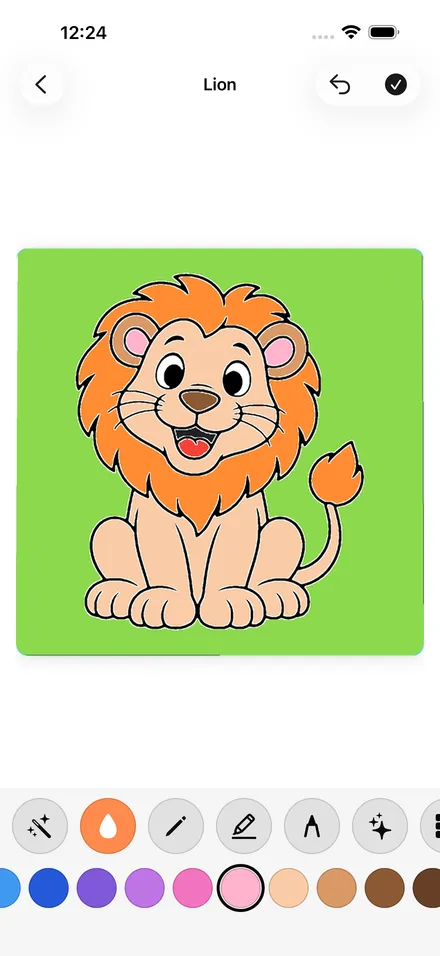
- Mix paper and screens thoughtfully. Tapping to fill a shape practices different movements from gripping a crayon. If your child uses a coloring app, keep crayons and paper in the rotation too.
Is coloring on paper better than coloring on a tablet?
They practice different things. A crayon on paper builds grip and pressure control, which a fingertip on glass does not. Digital coloring can still offer color choice, focus and conversation, especially when an adult sits alongside. Current pediatric guidance focuses on the quality and context of screen use rather than a single number. Read more in our guide to screen time and creative apps.
FAQ
At what age do kids benefit from coloring?
Children can start making marks with a crayon in the second year. Scribbling is on the CDC's 18-month milestone list. Coloring within shapes becomes more meaningful around ages 3 to 5, as grip and control mature. See when kids start coloring for an age-by-age guide.
Does coloring inside the lines matter?
Not much in the early years. Staying near the lines is a sign of growing control, but correcting it too often can take the fun out. Praise effort and choices, and let control come with practice.
Is coloring good for kids with big feelings?
It can be a calming, low-demand activity, and art gives children a way to express emotions. Evidence for anxiety reduction comes mainly from older children and adults, so treat it as a helpful routine, not a treatment.
Are coloring pages or blank paper better?
Both are worth doing. Coloring pages are good for control and color vocabulary. Blank paper is better for imagination and storytelling. A mix gives children the widest range of practice.
Where can I find free printable coloring pages?
Gullu has a free printable page in each of its 44 themes at gullu.app/coloring-pages/. Those pages are free for personal and classroom use (not for resale).
Sources
- CDC, "Important Milestones: Your Child By Four Years": https://www.cdc.gov/act-early/milestones/4-years.html
- CDC, "Important Milestones: Your Child By Five Years": https://www.cdc.gov/act-early/milestones/5-years.html
- CDC, "Important Milestones: Your Child By Eighteen Months": https://www.cdc.gov/act-early/milestones/18-months.html
- Schneck, C. M., & Henderson, A. (1990). Descriptive analysis of the developmental progression of grip position for pencil and crayon control in nondysfunctional children. American Journal of Occupational Therapy, 44(10), 893–900: https://doi.org/10.5014/ajot.44.10.893
- Cameron, C. E., et al. (2012). Fine motor skills and executive function both contribute to kindergarten achievement. Child Development, 83(4), 1229–1244: https://pmc.ncbi.nlm.nih.gov/articles/PMC3399936/
- Zero to Three, "Learning to Write and Draw": https://www.zerotothree.org/resource/learning-to-write-and-draw/
- NAEYC, "What Will We Make? Using Process Art to Spark Preschoolers' Development": https://www.naeyc.org/node/4824
- NAEYC (Bongiorno, L.), "How Process-Focused Art Experiences Support Preschoolers": https://www.naeyc.org/node/649
- Carsley, D., & Heath, N. L. (2019). Evaluating the effectiveness of a mindfulness coloring activity for test anxiety in children. The Journal of Educational Research, 112(2), 143–151: https://ideas.repec.org/a/taf/vjerxx/v112y2019i2p143-151.html