Gullu
Is Tracing Good for Kids? When to Start Tracing and How to Teach It
Short answer: Tracing is fine for preschoolers as one activity among several. The American Academy of Pediatrics says children can trace a square at about age 3 and enjoy tracing shapes like stars at 4 to 5. Two studies of 5-year-olds suggest that writing letters freehand helps letter learning in ways that tracing a printed letter may not, so mix tracing with copying and free drawing.
At what age do kids start tracing?
Around age 3 for simple shapes. The American Academy of Pediatrics says a 3-year-old has the finger control to trace a square, copy a circle or scribble freely. At 4 to 5, it lists tracing and copying geometric patterns, such as stars or diamonds, among children's favorite activities (AAP).
Before 3, most children are still scribbling. Zero to Three places controlled scribbling, with repeated circles and lines, at about 2 to 3 years, and notes that its timetables are approximate (Zero to Three). A 2-year-old who ignores the dotted line and scribbles over it is doing what 2-year-olds do.
| Age | What most children can do | Source |
|---|---|---|
| 2 to 3 | Controlled scribbles: repeated circles and lines | Zero to Three |
| 3 | Traces a square, copies a circle; draws a circle when shown how | AAP, CDC |
| 4 to 5 | Traces and copies patterns such as stars or diamonds | AAP |
| 5 | Writes some letters in their name | CDC |
What are the benefits of tracing?
Tracing gives a child practice steering a crayon along a set path, starting and stopping on purpose, and making shapes they cannot yet draw alone. The AAP groups tracing and copying patterns with drawing, cutting and clay modeling as activities that let 4- and 5-year-olds use and improve their emerging hand skills (AAP).
There is also a confidence benefit that parents see every day: a child who traces a star gets a star. That quick success can keep a reluctant drawer at the table. None of the sources here measured that, so take it as common experience, not a research finding.
Why do some teachers avoid tracing sheets?
Because many early childhood teachers prefer open-ended art. NAEYC's guide to process-focused art describes it as having no step-by-step instructions, no sample to follow and no right or wrong way. It contrasts that with product-focused art, where there is a right way to proceed and children may ask, "Is this right?" (NAEYC).
That NAEYC article does not mention tracing by name. But a tracing sheet has a sample and a right answer, so it sits on the product side of that line. The concern is balance. If every art activity has a correct result, children get less practice making their own choices.
Tracing, copying or free drawing: what does each practice?
They practice different things, and two studies of 5-year-olds help explain how. In a brain-imaging study, children who could not yet read printed, typed or traced letters. A brain network linked to reading responded to the letters only after the children had printed them by hand, not after typing or tracing (James & Engelhardt, 2012).
A later experiment with 72 five-year-olds compared six ways of learning new symbols, including copying them freehand and two kinds of tracing. What helped children recognize the symbols afterward was studying many varied versions of each one, whether or not their own hand produced them (Li & James, 2016). A child's own wobbly letters are varied by nature. Tracing the same printed letter again and again is not.
| Activity | What the child does | What it practices |
|---|---|---|
| Tracing | Follows a line that is already there | Steering the crayon, starting and stopping |
| Copying | Looks at a model, then makes it nearby | Remembering a shape and planning the strokes |
| Free drawing | Decides what to make and how | Ideas, planning, and the same hand control |
The last column is our summary, not a research result. The practical point from the two studies: use tracing as a warm-up, then let the child try the shape or letter without the guide.
When do kids trace letters and numbers?
Usually between 3 and 5, when interest in letters appears. Zero to Three places its letter and word practice stage at about 3 to 5 years and says children usually start with the letters in their own name (Zero to Three). By 5, most children write some letters in their name (CDC).
None of the official pages we read sets an age for tracing letters or numbers in particular. A good signal is the child asking how to write their name. The first letter of the name, drawn large, is a friendly place to start. Our alphabet coloring pages and number coloring pages have big letter and number shapes to color while you talk about them.
How do you teach a child to trace?
Start big and simple, and keep it short. These steps come from everyday practice with preschoolers, not from a study:
- Finger first. Have your child run a finger along a large shape before picking up a crayon.
- Start with lines and circles. Then squares and triangles. Our shapes coloring pages have bold outlines that work for this.
- Go big. A shape the size of a hand is easier than one the size of a coin.
- Do it together. The CDC suggests coloring and drawing lines and shapes with your 3-year-old (CDC).
- Fade the guide. Trace once, then try the same shape beside it without the line.
- Stop while it is still fun. A few minutes is enough.
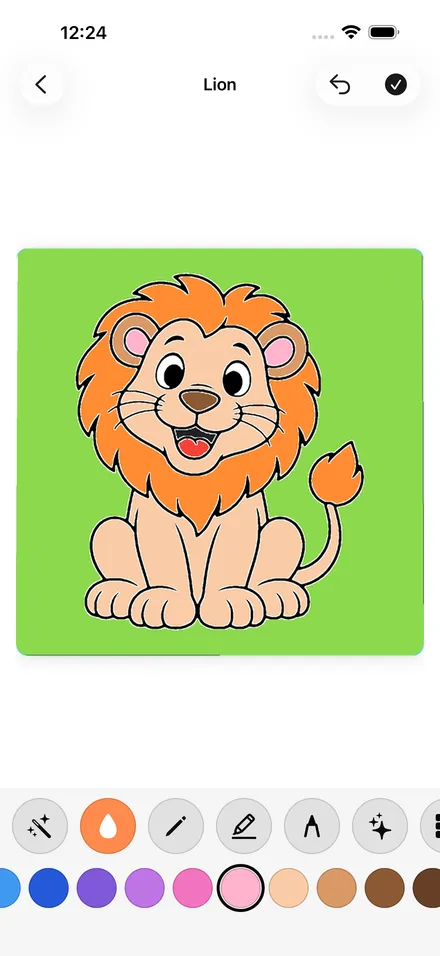
On a screen, the idea is the same. In Gullu, our coloring app for iPhone, iPad and Mac, a "Draw it" lesson shows a dotted guide part by part; the child traces it and then colors the drawing.
Is tracing bad for learning to draw?
Nothing we read shows that tracing harms drawing. The risk is only in doing nothing else. Zero to Three's advice is to let children experiment and explore, and to comment on what they are making instead of correcting it (Zero to Three).
A simple rule keeps the balance: for every traced page, offer a blank one. Our milestones by age guide describes what free drawing looks like at each stage, so you know what to expect on that blank page.
FAQ
Is tracing good for 2-year-olds?
Most 2-year-olds are still in the scribbling stages, and tracing a shape typically comes at about 3. Offer blank paper and chunky crayons. If they enjoy scribbling over a dotted shape, that is fine too.
Should preschoolers trace or copy letters?
Both, and then write them freehand. In a brain-imaging study of 5-year-olds, a reading-related network responded to letters after the children had printed them by hand, but not after tracing. Use tracing to show the path, then let them try alone.
Why can't my 3-year-old stay on the line?
Staying on a line takes fine control that is still developing at 3. The AAP says a 3-year-old can trace a square, not that the result will be neat. Use thick, large shapes and expect wobbles.
Do tracing sheets belong in a preschool classroom?
Many teachers use a few alongside open-ended art. Our guide to coloring activities for the preschool classroom has ideas that leave room for children's own choices.
Sources
- HealthyChildren.org (AAP), "Hand and Finger Skills of Your Preschooler": https://www.healthychildren.org/English/ages-stages/preschool/Pages/Hand-and-Finger-Skills-of-Your-Preschooler.aspx
- Zero to Three, "Learning to Write and Draw": https://www.zerotothree.org/resource/learning-to-write-and-draw/
- CDC, "Important Milestones: Your Child By Three Years": https://www.cdc.gov/act-early/milestones/3-years.html
- CDC, "Important Milestones: Your Child By Five Years": https://www.cdc.gov/act-early/milestones/5-years.html
- Bongiorno, L. (2014). How Process-Focused Art Experiences Support Preschoolers. Teaching Young Children, 7(3), NAEYC: https://www.naeyc.org/resources/pubs/tyc/feb2014/process-art-experiences
- James, K. H., & Engelhardt, L. (2012). The effects of handwriting experience on functional brain development in pre-literate children. Trends in Neuroscience and Education, 1(1), 32–42: https://pubmed.ncbi.nlm.nih.gov/25541600/
- Li, J. X., & James, K. H. (2016). Handwriting generates variable visual output to facilitate symbol learning. Journal of Experimental Psychology: General, 145(3), 298–313: https://pubmed.ncbi.nlm.nih.gov/26726913/