Gullu
When Do Kids Learn Colors? Ages, Why It Takes Time and How to Teach Them
Short answer: Most children show they know at least one color by 30 months and name a few colors by age 4, according to the CDC milestone checklists. Color words are learned later than many parents expect, and the pace varies widely from child to child. Naming colors in everyday talk, with the object first and the color second, is a simple way to help.
When do toddlers learn colors?
Between about 2½ and 4 for most children. The CDC lists showing knowledge of at least one color by 30 months, for example pointing to the red crayon when asked which one is red, and naming a few colors of items by 4 years (CDC, 30 months; CDC, 4 years).
Notice the two different skills. Pointing to a color someone else names comes first. Saying the right color word yourself comes later.
| Age | What the CDC lists | What you can do |
|---|---|---|
| 18 months | No color milestone. A tip suggests simple choices, such as a red or a blue shirt | Use color words in everyday choices |
| 2 years | No color milestone. A tip suggests simple puzzles with shapes, colors or animals | Name each piece as it goes in |
| 30 months | Shows they know at least one color | Ask "Which one is red?" during play |
| 4 years | Names a few colors of items | Ask the color of things you see during the day |
The CDC describes milestones as things most children can do by that age, so many children get there earlier.
Should a 2-year-old know colors?
Not necessarily. The CDC's 2-year checklist has no color milestone at all, and the first one, knowing at least one color, appears at 30 months (CDC, 2 years). A 2-year-old who calls everything "blue" or answers a color question with a random color word is doing something researchers have described for decades.
A research review of early color naming reported that beginners' errors tend to be random or stuck on one word, that correct naming seems to have a minimum age, and that the pace differs widely between children (Bornstein, 1985).
How many colors should a 3-year-old know?
There is no official number. The CDC's 3-year checklist does not mention colors. The nearest markers are on either side: at least one color by 30 months and a few colors named by 4 (CDC, 3 years). A 3-year-old anywhere between those two points is within what the checklists describe.
Charts that promise an exact count for each birthday go beyond what the CDC lists. Some 3-year-olds name ten colors and others name one or two. The 1985 review also noted that girls are generally a little faster than boys at this, so comparing siblings is not very useful.
Why are color words hard to learn?
Because learning the word is harder than seeing the color. The same review points out that even young infants can tell colors apart and group them, yet consistent color naming comes surprisingly late (Bornstein, 1985). A 2006 commentary argues that several hurdles are involved at once: understanding the idea, paying attention to it, and the language itself (Franklin, 2006).
That commentary adds two reassuring notes. The age at which children learn color words has been getting younger, and color may be no harder than other abstract qualities.
A Scientific American article by a language researcher gives a plain example of the attention problem. Color is everywhere, so when a toddler hears "red" there are usually several colors in view. A word like "dog" tends to come up when one dog is in sight, which makes it easier to pin down (Dye, 2010).
How do you teach a toddler colors?
Name colors in ordinary moments, and put the object first. In the study described in Scientific American, 2-year-olds trained with sentences like "This crayon is green" improved on a color test, while those who heard "This is a green crayon" did not (Dye, 2010). The article describes a small experiment, so treat it as a useful tip, not a rule.
The CDC's own tips are simple:
- Offer color choices when dressing, such as the red shirt or the blue one (CDC, 18 months)
- Name puzzle pieces by shape, color or animal as your child places them (CDC, 2 years).
- Encourage naming colors and pictures in books (CDC, 30 months).
- Ask about color, shape and size of things you see during the day (CDC, 4 years).
A few more that fit the same idea:
- Start with two colors that look very different, then add more.
- Sort things. Socks, blocks or toy cars into color piles.
- Keep it playful. Quizzing can turn a game into a test.
Does coloring help kids learn color names?
It gives you many natural chances to say them, which is what the CDC's tips rely on. We did not find a study that tests coloring pages against other ways of teaching color words, so we make no claim that coloring teaches colors faster. What a coloring page offers is a reason to talk: "The frog is green. Which one is the green one?"
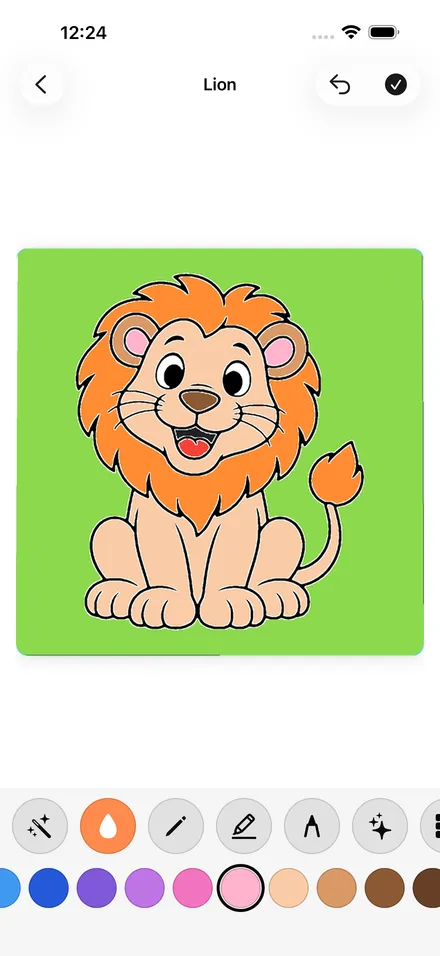
Good pages for color talk have objects with familiar colors, such as rainbows, fruits and food. The same works on a screen: when your child picks a color in the browser at Color Online, say its name. Let them choose "wrong" colors too. A purple banana is a chance to say "purple."
For what else coloring practices, see benefits of coloring for kids.
What if my child mixes up colors at 4?
Mixing up some colors at 4 is common, since the CDC milestone is naming a few, not all. If a child seems to have real trouble learning colors, the US National Eye Institute says that is a reason to have their eyes tested for color vision deficiency, especially with a family history (National Eye Institute).
The institute notes that about 1 in 12 men have a color vision deficiency, that it can be hard to spot in children, and that an eye doctor can usually check with a simple test. Only an eye doctor can tell you whether that is the cause. Do not try to diagnose it at home from coloring.
When should I talk to a doctor?
The CDC advises talking with your child's doctor and asking about developmental screening if your child is not meeting one or more milestones for their age, has lost skills they once had, or you have other concerns (CDC milestones). For colors, the listed points are one color known by 30 months and a few named by 4.
FAQ
What colors do kids learn first?
The sources we read do not give a fixed order. In practice children tend to learn the colors they hear named most often, so the first ones vary by home and language.
Is it normal for a 3-year-old not to know colors?
The CDC's 3-year checklist has no color milestone. Knowing at least one color is listed at 30 months and naming a few at 4, so a 3-year-old who is still learning is within that span.
Do boys learn colors later than girls?
A 1985 research review reported that girls are generally faster at color naming. It also reported wide differences between individual children, which matter more than the average.
Should I correct my child when they name the wrong color?
Say the right word in a friendly sentence, object first: "That car is yellow." Then move on. Frequent quizzing is not part of the CDC's tips.
When do kids start coloring with crayons?
See when kids start coloring for milestones from ages 1 to 7.
Sources
- CDC, "CDC's Developmental Milestones": https://www.cdc.gov/act-early/milestones/index.html
- CDC, "Milestones by 18 Months": https://www.cdc.gov/act-early/milestones/18-months.html
- CDC, "Milestones by 2 Years": https://www.cdc.gov/act-early/milestones/2-years.html
- CDC, "Milestones by 30 Months": https://www.cdc.gov/act-early/milestones/30-months.html
- CDC, "Milestones by 3 Years": https://www.cdc.gov/act-early/milestones/3-years.html
- CDC, "Milestones by 4 Years": https://www.cdc.gov/act-early/milestones/4-years.html
- Bornstein, M. H. (1985). On the development of color naming in young children: data and theory. Brain and Language, 26(1), 72–93: https://pubmed.ncbi.nlm.nih.gov/2413957/
- Franklin, A. (2006). Constraints on children's color term acquisition. Journal of Experimental Child Psychology, 94(4), 322–327: https://pubmed.ncbi.nlm.nih.gov/16600284/
- Dye, M. (2010). "Why Johnny Can't Name His Colors." Scientific American: https://www.scientificamerican.com/article/why-johnny-name-colors/
- National Eye Institute, "Color Blindness": https://www.nei.nih.gov/learn-about-eye-health/eye-conditions-and-diseases/color-blindness