Gullu
Restaurant Activities for Kids: 15 Quiet Table Ideas for Ages 2 to 5
Short answer: A piece of paper and a few crayons is often all it takes to keep a young child busy at a restaurant, according to the American Academy of Pediatrics. Pack a small bag with two or three quiet things, go early, and order as soon as you sit down. The CDC lists 5 to 10 minutes of attention on one activity as typical at age 5, so plan several short activities.
Why is sitting through a restaurant meal hard for young children?
Because it asks for a lot of waiting, and waiting is a skill still being learned. The American Academy of Pediatrics (AAP) says eating out takes many social skills that children have to learn and practice, and that boredom and impatience cause many restaurant problems. It adds that the clock starts the moment you walk in (AAP, eating out).
The CDC's milestone list gives a sense of scale. Most 5-year-olds pay attention for 5 to 10 minutes during an activity such as story time or arts and crafts, and the CDC notes that screen time does not count (CDC, 5 years). The CDC gives no figure for younger children. A restaurant meal lasts a good deal longer than 10 minutes.
So the plan is simple. Shorten the wait where you can, and fill the rest with several small activities, not one big one.
The AAP's tips for shortening the wait:
- Reserve or call ahead so you skip the waiting area.
- Go early. You beat the rush, service is faster and your child is less tired.
- Order everything at once, the first chance you get.
- Ask for the check with the meal if you may need a quick exit.
- Clear the table. Move knives, candles, sugar packets and drinks out of reach before anyone sits.
What fits in a small bag for a 2- to 5-year-old?
Two or three quiet things, and at least one that is new. The AAP suggests bringing a couple of books and a quiet toy or two, and notes that items the child has not seen before work especially well.
| Age | What to pack | Why it works |
|---|---|---|
| 2 years | 3 or 4 thick crayons, a few coloring pages, a board book, stickers | Short activities, nothing that rolls far |
| 3 years | Crayons, half-size coloring pages, a small pad, a water-reveal pad | Can color a simple picture with you |
| 4 years | Crayons or pencils, pages, a notepad, a few cards for matching | Ready for simple games with rules |
| 5 years | Pencil and pad, pages, a small card game | Can play tic-tac-toe and keep score |
The "why it works" column is our practical reading. The CDC lists games with rules, such as simple card and board games, among its tips at age 5.
Keep the bag packed and by the door. NAEYC, the US early childhood association, suggests filling a backpack with writing tools and paper to take in the car or on errands (NAEYC). With children under 3, keep small items such as crayon pieces and stickers within your sight, since they can be choking hazards.
What are 15 quiet table ideas?
With paper and crayons
- A coloring page. One page per child, plus a spare.
- Draw the order. Your child draws what they asked for, then checks it against the plate.
- Take turns drawing. You draw a circle, your child turns it into something.
- Tic-tac-toe. The CDC lists it among games that help memory and attention at 5.
- The reverse list. NAEYC suggests giving a child a pad and pencil to "write" a list while you run errands. At the table, it can be a list of everything on it.
- Color hunt. Color one thing red, one thing blue, one thing green.
- Place cards. Each person's name or first letter on a folded scrap. See when should a child write their name.
With what is in the bag
- A new small book. Read it quietly together.
- Stickers on paper. Make a scene, then tell its story.
- A water-reveal pad. Nothing to spill but water. See mess-free coloring.
- A matching game with a few cards.
With nothing at all
- I Spy. On the CDC's list for age 5. With younger children, use colors: "I spy something yellow."
- Hot and Cold. Also on the CDC's list. Think of one thing on the table and guide your child's guesses with "warmer" and "colder."
- Count it. Chairs, lights, forks. The CDC suggests counting simple things with 4-year-olds.
- Tell a story in turns. One sentence each.
Which coloring pages work without a full crayon box?
Pages with large, simple shapes, since three or four crayons can finish them. Look for:
- Big areas and thick lines, such as bold and easy pages or pages for toddlers.
- One main subject, such as an animal or a truck, with little background.
- Subjects that suit any color. A dinosaur can be purple. A banana next to a fire truck needs two specific crayons.
Print pages at half size, two to a sheet, so they fit beside a plate. How to print coloring pages shows the setting. For crayons, pick three or four in different colors and carry them in a small zip bag or tin.
Some restaurants hand out crayons, which the AAP mentions as one sign of a family-friendly place. Your own page is a backup when they do not.
Which table games need nothing at all?
The CDC's tips for 5-year-olds list card games, Tic Tac Toe, I Spy and Hot and Cold as games that help with memory and attention, and Simon Says for following rules (CDC, 5 years). Three of those need no equipment.
More that fit a table:
- What's missing? Put four things on the table. Your child closes their eyes, you hide one.
- Quiet Simon Says. Small movements only: touch your nose, blink twice.
These are our suggestions in the same spirit as the CDC's list.
What about waiting rooms and lines?
The same bag works, with two changes. First, in a doctor's waiting room, your own crayons and pages are simpler than shared toys. Second, a line means standing, so use games that need no hands.
- In a waiting room: a coloring page on a clipboard or hardcover book, a sticker sheet, a quiet story.
- In a line: I Spy, counting people ahead of you, finding letters on signs.
- On errands: NAEYC suggests offering a pad and pencil so children can "write" alongside you. At the bank, for example, give them a blank slip while you fill out yours.
For the CDC's "stop and wait" skill, it suggests playing red light, green light or freeze dance at home with 4-year-olds (CDC, 4 years). That gives your child a way to practice before they need the skill in public.
For longer waits, see quiet time activities, airplane activities for toddlers and road trip activities for kids.
Is a phone at the table OK?
It is your call. Here is what the official guidance says. The CDC's tips suggest avoiding screen time during meals at 30 months and again at 5 years (CDC, 30 months). The AAP's family media guidance suggests keeping mealtimes screen-free, lists the dinner table as a screen-free zone, and asks parents to put their own phones away at meals too (AAP, media policy explained; AAP, family media plan).
Neither AAP page talks about restaurants or waiting rooms in particular. The AAP's wider message is to look beyond simple time limits to quality, context and conversation, and to make a plan that fits your own family.
A workable approach:
- Paper first. Start with crayons and games.
- Screens off while eating. Food on the table means devices away, for adults too.
- If you do use a screen, choose something calm, quiet and without ads, and use it together. A coloring app is one option, since your child is making something and you can talk about it.
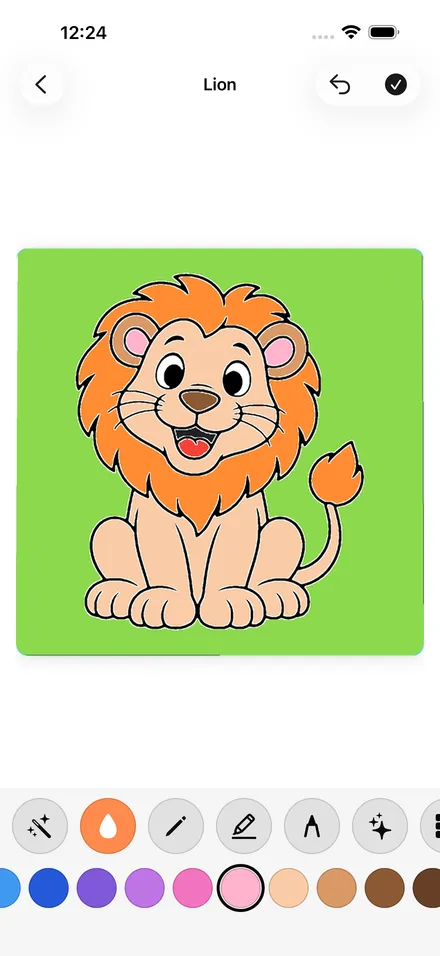
Gullu is one option for that fallback. On iPhone, iPad and Mac it has no ads, and once installed it works with no Wi-Fi or mobile data. See screen time and creative apps for how to fit an app into the day.
What goes in a printable restaurant kit?
- Print 4 to 6 coloring pages at two per sheet and cut them in half. The free coloring pages on this site include 100 free printables.
- Add blank paper for drawing and tic-tac-toe.
- Pick 4 crayons in different colors.
- Add one sticker sheet and one small book.
- Put it all in a zip bag or flat pouch and leave it in your bag or car.
Refill it when you get home, with new pages each time.
FAQ
How do I keep a 2-year-old busy at a restaurant?
Go early, order at once, and bring two or three quiet things such as thick crayons, a coloring page and a board book. Expect short bursts of attention and switch activities often.
What should I do if my child melts down at the table?
The AAP suggests setting clear expectations before you go and being ready to follow through, even if that means leaving before the meal arrives. Asking for the check early makes that easier.
Are restaurant crayons safe?
A US poison center rates crayon toxicity as minimal to none, but crayons can be a choking hazard for young children. See my toddler ate a crayon.
How long can a preschooler sit at a restaurant?
No official source gives a number for restaurants. The CDC lists 5 to 10 minutes of attention on one activity at age 5. See how long kids can sit and color.
What can kids do at a wedding or long family dinner?
The same kit works, with more pages. For a larger group, see Thanksgiving kids' table activities.
Sources
- American Academy of Pediatrics, HealthyChildren.org, "Eating Out Without Reservations" (from Food Fights, 2nd edition, 2012): https://www.healthychildren.org/English/ages-stages/preschool/nutrition-fitness/Pages/Eating-Out-Without-Reservations.aspx
- American Academy of Pediatrics, HealthyChildren.org, "Helping Kids Thrive in a Digital World: AAP Policy Explained": https://www.healthychildren.org/English/family-life/Media/Pages/helping-kids-thrive-in-a-digital-world-AAP-policy-explained.aspx
- American Academy of Pediatrics, HealthyChildren.org, "How to Make a Family Media Use Plan": https://www.healthychildren.org/English/family-life/Media/Pages/How-to-Make-a-Family-Media-Use-Plan.aspx
- CDC, "Milestones by 30 Months": https://www.cdc.gov/act-early/milestones/30-months.html
- CDC, "Milestones by 4 Years": https://www.cdc.gov/act-early/milestones/4-years.html
- CDC, "Milestones by 5 Years": https://www.cdc.gov/act-early/milestones/5-years.html
- NAEYC, "Support Writing at Home": https://www.naeyc.org/our-work/families/support-writing-home
- Children's Hospital of Philadelphia, Poison Control Center, "Crayons": https://www.chop.edu/centers-programs/poison-control-center/crayons