Gullu
Mess-Free Coloring for Toddlers: 7 Options Compared for Home, Car and Travel
Short answer: The lowest-mess options for toddlers are water-reveal pads, clear-ink markers that show only on their own paper, plain water with a brush outdoors, and a coloring app. Washable crayons and markers still leave marks, and their makers say cleaning results are not guaranteed. Whatever you choose, look for the AP seal and stay close, because crayons and caps are choking hazards.
What counts as mess-free coloring?
Anything that leaves color on the page and nowhere else. No official body defines the term. In practice it covers two groups: tools that cannot mark walls or clothes at all, and ordinary tools used in a way that keeps the marks contained.
Here are seven options side by side. The notes on mess are our practical reading, based on how the makers describe their own products.
| Option | How it works | Mess | Good for |
|---|---|---|---|
| Water-reveal pads | A pen filled with water makes hidden colors appear | Water only | Car, plane, restaurant |
| Clear-ink markers with special paper | Ink shows only on the matching paper | None on skin or fabric, per the maker | Car, sofa, travel |
| Plain water and a paintbrush outdoors | "Paint" a fence or sidewalk with water | Dries away | Yard, balcony |
| Sidewalk chalk | Chalk on pavement | Dust on hands and knees | Outdoors |
| Washable crayons and markers | Ordinary coloring with easier cleanup | Low to medium | Home, at a table |
| Regular crayons with a contained setup | Taped paper, tray or mat | Low on skin, can mark walls | Home, restaurant |
| A coloring app | Color on a screen | None | Travel, waiting |
How do water-reveal and special-paper markers work?
Both keep the color inside the page, in different ways. We describe them generically here and name no product as a recommendation.
Water-reveal pads. The child colors with a chunky pen filled with plain water. One maker describes its pad as reusable and no-mess: the scene appears as the water pen passes over the page, and when the page dries the picture disappears so it can be used again. That maker marks its pad for ages 3 and up, so check the age on the one you buy (maker's product page).
The only thing that can spill is a little water. The pen is the one loose part to keep track of.
Clear-ink markers with special paper. Here the marker ink is made to appear only on the paper sold with it. One maker states that its inks appear only on its specially formulated paper and will not color on fabric, skin or furniture (maker's page).
The trade-off is that the markers do nothing on ordinary paper, so you need the matching pads or sheets. The marker caps are small parts.
Neither maker's page explains the chemistry, so we do not guess at it.
Are washable crayons and markers really washable?
Mostly, with effort, and not always. "Washable" means easier to clean, not that marks vanish. One large maker's own stain guides end with the line "Results May Vary, Test First!" and say that while its methods were tested successfully, it cannot guarantee results.
Its instructions for washable marker on clothing show what "washable" can involve: rinse with hot water until no more color comes out, machine wash in hot water with detergent, soak for an hour in an oxygen-type color-safe bleach, air dry, and repeat if needed. It warns not to put the garment in the dryer between washes, and notes that ink left on fabric for a long time may need extra cleaning (maker's stain guide, clothing).
So washable tools are a sensible choice for home. They are not a reason to hand a toddler a marker on a white sofa.
Are mess-free products safe for toddlers?
Check the label, as you would for any art supply.
- Look for the AP seal. The Art and Creative Materials Institute says products with its AP (Approved Product) seal have been evaluated by a toxicologist and contain no materials in quantities that would be toxic or harmful to people, including children (ACMI).
- In the US, look for "Conforms to ASTM D-4236." Art materials sold there must carry this statement and be assessed for long-term hazards at least every five years (CPSC). Other countries have their own rules.
- Watch small parts. The Poison Control Center at Children's Hospital of Philadelphia rates crayon toxicity as minimal to none, but warns that crayons can be a choking hazard like any small toy (CHOP). The same care applies to caps and water pens.
If a child is choking or has trouble breathing, call your emergency number at once (911 in the US). For what to do when a child eats crayon, see my toddler ate a crayon.
Is a coloring app a fair substitute?
It is a fair mess-free option, and a different activity. Nothing spills, breaks or rolls under a seat. But tapping a screen is not the same hand work as gripping and pressing a crayon, so an app sits beside paper coloring, not in place of it.
Screen time is the other consideration. The CDC's tips for 2- and 3-year-olds suggest limiting screen time to no more than 1 hour a day (CDC, 2 years). The American Academy of Pediatrics' current guidance for families puts more weight on quality, context and conversation than on a number, and suggests watching and playing together with young children (AAP).
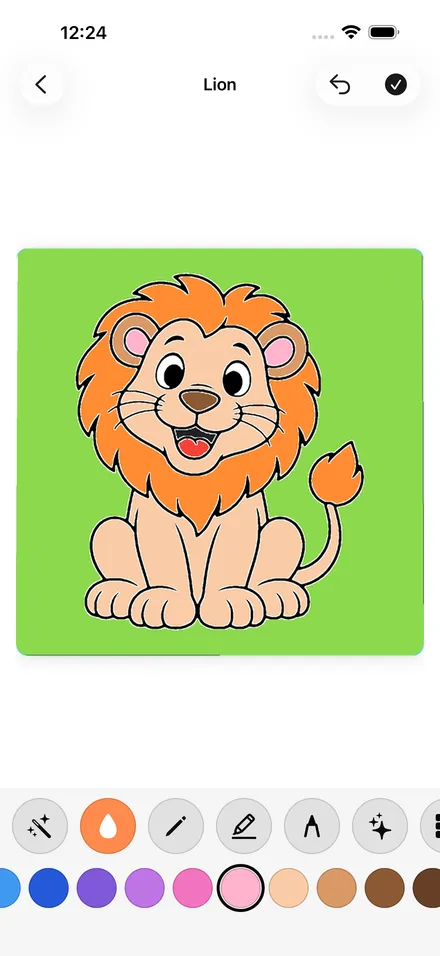
If you use an app, pick one without ads and sit with your child when you can. Gullu is one such app: on iPhone, iPad and Mac it has no ads, and once installed it works with no Wi-Fi or mobile data. For how apps fit into a day, see screen time and creative apps and choosing a coloring app.
What works in the car, on a plane and at a restaurant?
Match the tool to the place.
In the car. Water-reveal pads and clear-ink markers suit a car seat, since neither can mark the upholstery. One caution for children who get carsick: the AAP advises having them look at things outside the car, not at books or games (AAP, car sickness). For those children, save coloring for the stops. More ideas are in road trip activities for kids.
On a plane. A tray table is small and crayons roll. A water-reveal pad, a small pad with three or four crayons in a zip bag, or an app that works offline all fit. See airplane activities for toddlers.
At a restaurant. Paper and a few crayons are the classic. The AAP's own advice on eating out says that for older children, a piece of paper and a few crayons is often all it takes (AAP, eating out). Skip markers near tablecloths. See restaurant activities for kids.
At home. Contain the mess instead of removing it. Tape paper to the table, use a tray or a wipe-clean mat, and keep marker caps in a bowl. The CDC suggests letting a 2½-year-old draw with chalk on a sidewalk, and NAEYC suggests old paintbrushes and water on sidewalks and fences (CDC, 30 months; NAEYC). NAEYC also suggests a simple house rule: remind your child to write on the paper and nowhere else.
For choosing between ordinary tools, see crayons, markers or pencils.
How do you get crayon off walls and tables?
Start mild and work up. These steps come from a large crayon maker's own stain guides. Its pages name specific cleaning brands. We give the generic type.
Regular crayon on a painted wall (maker's guide):
- Spray with an all-purpose cleaner and wipe with paper towels.
- If the mark remains, use a sponge dampened with warm water and liquid dish soap, and work in circles.
- Rinse with water and dry. Repeat as needed.
- A melamine foam eraser sponge is its alternative suggestion.
Washable crayon on a painted wall (maker's guide): wash with dish soap in water, in circles, with a soft cloth or sponge, then rinse. The guide notes that fresh marks are most easily removed. For what is left on white walls, it suggests a mild abrasive cleanser or toothpaste.
Washable marker on a painted wall (maker's guide): wipe with a damp sponge first. If a stain remains, use a mild abrasive cleanser, then blot with rubbing alcohol on a cotton ball and rinse.
All three pages carry the same warning: results may vary, so test on a hidden spot first. The steps are written for that maker's products. Keep cleaning products out of your child's reach while you work.
FAQ
What is the least messy way for a 2-year-old to color?
A water-reveal pad, clear-ink markers with their own paper, or a brush and plain water outdoors. Check the age marked on any product. Stay beside your child, since pens and caps are small parts.
Do mess-free markers work on regular paper?
No. Clear-ink markers of this kind are made to show only on the matching paper, according to the maker's page we read.
Can water-reveal pads be reused?
Yes, according to the maker's page we read. The picture fades as the page dries and can be colored again.
Do washable markers come out of clothes?
Often, but not always. The maker's own guide lists several wash and soak steps and says results are not guaranteed. Do not machine dry the item until the stain is gone.
Is a coloring app better than mess-free markers?
Neither is better. A marker gives real grip practice, and an app has nothing to lose or spill. One simple split is paper at home and an app for travel.
Sources
- Art and Creative Materials Institute, "Materials Safety": https://www.acmiart.org/materials-safety
- U.S. Consumer Product Safety Commission, "Art Materials" business guidance: https://www.cpsc.gov/Business--Manufacturing/Business-Education/Business-Guidance/Art-Materials
- Children's Hospital of Philadelphia, Poison Control Center, "Crayons": https://www.chop.edu/centers-programs/poison-control-center/crayons
- CDC, "Milestones by 2 Years": https://www.cdc.gov/act-early/milestones/2-years.html
- CDC, "Milestones by 30 Months": https://www.cdc.gov/act-early/milestones/30-months.html
- CDC, "Milestones by 3 Years": https://www.cdc.gov/act-early/milestones/3-years.html
- American Academy of Pediatrics, HealthyChildren.org, "Helping Kids Thrive in a Digital World: AAP Policy Explained": https://www.healthychildren.org/English/family-life/Media/Pages/helping-kids-thrive-in-a-digital-world-AAP-policy-explained.aspx
- American Academy of Pediatrics, HealthyChildren.org, "Car Sickness": https://www.healthychildren.org/English/health-issues/conditions/head-neck-nervous-system/Pages/Car-Sickness.aspx
- American Academy of Pediatrics, HealthyChildren.org, "Eating Out Without Reservations": https://www.healthychildren.org/English/ages-stages/preschool/nutrition-fitness/Pages/Eating-Out-Without-Reservations.aspx
- NAEYC, "Support Writing at Home": https://www.naeyc.org/our-work/families/support-writing-home
- Melissa & Doug, water-reveal pad product page (maker's description): https://www.melissaanddoug.com/products/water-wow-farm-on-the-go-travel-activity
- Crayola, clear-ink marker feature page (maker's description): https://www.crayola.com/feature/color-wonder
- Crayola, stain tips, "Washable Markers on Clothing or Fabrics": https://www.crayola.com/stain-tips/washable-markers-on-clothing-or-fabrics-stain-tip
- Crayola, stain tips, "Regular Crayons on Painted Walls": https://www.crayola.com/stain-tips/regular-crayons-on-painted-walls-stain-tip
- Crayola, stain tips, "Ultra Clean and Washable Crayons on Painted Walls": https://www.crayola.com/support/stain-tips/detail-surface/ultra-clean-and-washable-crayons/ultra-clean-and-washable-crayons-on-painted-walls
- Crayola, stain tips, "Washable Markers on Painted Walls": https://www.crayola.com/stain-tips/washable-markers-on-painted-walls-stain-tip