Gullu
Coloring for 2-Year-Olds: What to Expect and What to Put on the Table
Short answer: A 2-year-old can color, but at this age coloring means scribbling. Zero to Three describes random scribbling from about 15 months to 2½ years and more controlled scribbling from 2 to 3. The CDC suggests giving a 2-year-old crayons or finger paint and letting them explore, so offer big paper, a few sturdy crayons and pages with one large shape.
What does coloring look like at 2?
Scribbles, made with the whole arm, that pay no attention to any printed line. That is exactly what the sources describe for this age.
Zero to Three, a US nonprofit for early development, lays out the early stages like this (Zero to Three):
| Age (approximate) | Stage | What you see |
|---|---|---|
| 15 months to 2½ years | Random scribbling | Large arm movements, crayon held in a fist. The child is finding out that moving makes marks |
| 2 to 3 years | Controlled scribbling | Repeated lines, curves and circles made on purpose. The grip starts to move toward thumb and pointer finger |
| 2½ to 3½ years | Lines and patterns | Marks that imitate writing. The child may tell you what they "say" |
The stages overlap, and Zero to Three notes that the ages are approximate.
The CDC milestone lists tell the same story. "Scribbles" is a milestone at 18 months. The 2-year list has no drawing or coloring milestone. At 30 months, a tip suggests drawing a straight line to see if your child will copy it, then showing a circle once lines go well (CDC, 30 months). Drawing a circle after being shown how appears as a milestone at 3 years.
So a 2-year-old who covers a picture of a duck in purple loops is on track. For the full path from age 1 to 7, see when kids start coloring.
Are coloring books good for 2-year-olds?
They are fine as one more surface to scribble on. Just do not expect the picture to be "colored in."
The CDC's tips for 2-year-olds suggest simple art projects: give your child crayons or put some finger paint on paper, let them explore by spreading it around and making dots, and hang the result on the wall or refrigerator (CDC, 2 years). The American Academy of Pediatrics also names crayons and finger paints as creative activities that help a 2-year-old's hand skills develop (AAP).
Notice that the CDC's coloring book tip comes a year later. An "activity box" with paper, crayons and coloring books is on its list for 3-year-olds.
What that means in practice:
- Blank paper first. It has no right answer.
- Coloring pages as an extra. Some 2-year-olds love having a dog or a ball to scribble on and name.
- No correcting. Zero to Three's advice is to let children explore without step-by-step directions.
For the wider debate, see are coloring pages bad for kids.
Which pages work for a 2-year-old?
Pages with one big, familiar shape and thick outlines. We found no official source that sets rules for coloring page design, so this is practical reasoning from what the sources say about the age: big arm movements and a fist grip need big targets.
Look for:
- One subject per page. A ball, an apple, a puppy.
- Few sections. Three or four spaces, not thirty.
- Bold lines that are easy to see.
- Things your child can name. The CDC's 30-month tips encourage naming pictures and colors.
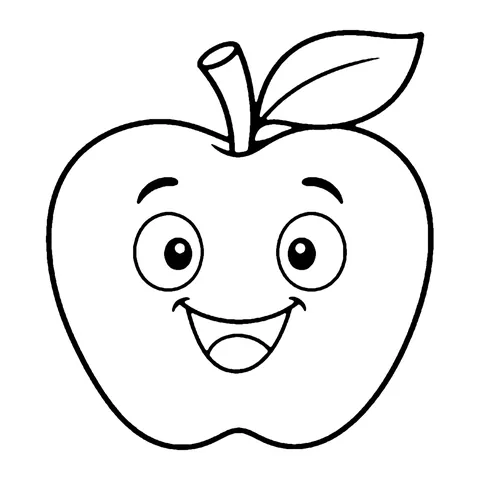
Our toddler coloring pages gather the easiest pictures on the site, and six of them are free to print, such as the Puppy with Bone, the Apple and the Lollipop. The bold and easy pages are similar.
Two tips for the paper itself. Tape the page to the table so it does not slide under a big arm movement. And print a few copies, since a 2-year-old may be done with one in under a minute.
Which crayons fit a 2-year-old's hand?
Sturdy ones that are comfortable in a fist, and too big to be a choking risk.
Zero to Three describes children in the random scribbling stage as holding the crayon in a fist. A thick crayon is easier to wrap a fist around and harder to snap, which is why many parents pick chunky ones for this age. That is a practical point, not a finding from a study.
Safety matters more than shape:
- They will go in the mouth. The AAP notes that 2-year-olds still put objects in their mouths.
- Choking is the real risk. The poison control center at Children's Hospital of Philadelphia rates crayon toxicity as minimal to none, and warns that crayons can be a choking hazard like any toy that fits in a child's mouth (CHOP). Take away small broken stubs.
- Look for the AP seal. CHOP recommends art materials certified as non-toxic, marked with the AP seal.
- Stay close. Coloring at 2 is a together activity.
If your child has eaten some crayon, read my toddler ate a crayon. To compare tools, see crayons, markers or pencils, and for no-stain options see mess-free coloring.
How long will a 2-year-old color?
Often only a few minutes, and that is fine. We found no official figure for age 2.
The nearest number is for much older children. The CDC lists paying attention for 5 to 10 minutes during activities such as story time or crafts as a milestone at 5 years (CDC, 5 years). If that is typical at 5, a 2-year-old who scribbles hard for two minutes and walks off is not showing a problem.
Ways to work with a short span:
- Leave the paper out. Many toddlers come back several times.
- Change one thing. A new color, a bigger sheet, or chalk outside.
- Stop when they stop. Finishing the page is an adult goal.
More on this in how long kids can sit and color.
How do you color together without taking over?
Sit beside your child with your own sheet, and talk about what they are doing more than what they have made.
Zero to Three's suggestions include these:
- No instructions. Let your child explore the materials in their own way.
- Notice the process, not just the product. Say what you see: "You made so many lines," or "You are pressing hard."
- Take their marks seriously. If your child says the scribble is a shopping list, it is a shopping list.
- Show the work. Displaying it tells your child it matters. The CDC's 2-year tip says the same: hang it on the wall or refrigerator.
Things to avoid at this age: holding their hand to guide it, fixing the "wrong" color, and coloring their page for them. Draw on your own sheet. If your child copies your line, good. The CDC's 30-month tip is to draw a straight line and see if they copy it.
Coloring is also an easy time for color words. The CDC lists knowing at least one color at 30 months, so at 2 you are only planting the words. See when kids learn colors.
What about coloring apps for a 2-year-old?
Go slowly, and stay with your child. The official screen limits for this age are tight.
- Under 2: the CDC's 18-month tips say screen time is not recommended for children younger than 2, other than video calling with loved ones (CDC, 18 months).
- At 2: the CDC says to "limit screen time (TV, tablets, phones, etc.) to no more than 1 hour a day of a children's program with an adult present." The World Health Organization says that for 2-year-olds, "sedentary screen time should be no more than 1 hour; less is better" (WHO).
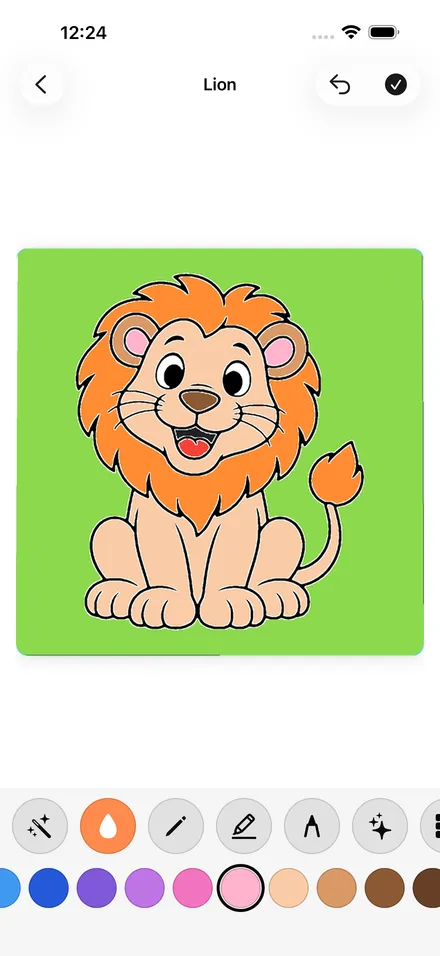
An honest note about our own app. Gullu is designed for ages 3 to 7, so a 2-year-old is below the age it was made for. It does have a Simple mode that shows only two tools, the magic brush and tap to fill, for the youngest children. If you try it with a 2-year-old, treat it as a few minutes together inside the daily limit. Paper and crayons remain the main thing at this age.
For more, see screen time and creative apps.
FAQ
Can a 2-year-old color inside the lines?
No, and none of the sources we read expect it. Zero to Three describes ages 2 to 3 as controlled scribbling. See coloring inside the lines for when it usually comes.
Should a 2-year-old hold a crayon properly?
A fist grip is what Zero to Three describes for early scribbling. The CDC lists holding a crayon between fingers and thumb, not a fist, as a milestone at 4 years. See pencil grip by age.
Are crayons safe for a 2-year-old?
A US poison control center rates their toxicity as minimal to none but warns of choking. Choose crayons with the AP seal, remove small stubs and stay with your child.
My 2-year-old will not color. Is that a problem?
The CDC's 2-year checklist has no coloring or drawing milestone. If you have concerns about your child's development, the CDC advises talking with your child's doctor. For ideas, see my child does not like coloring.
Which hand should a 2-year-old color with?
Either. The AAP says many children show a hand preference by about 24 months, others not for several years, and that parents should not push one hand over the other.
Sources
- Zero to Three, "Learning to Write and Draw": https://www.zerotothree.org/resource/learning-to-write-and-draw/
- CDC, "Milestones by 18 Months": https://www.cdc.gov/act-early/milestones/18-months.html
- CDC, "Milestones by 2 Years": https://www.cdc.gov/act-early/milestones/2-years.html
- CDC, "Milestones by 30 Months": https://www.cdc.gov/act-early/milestones/30-months.html
- CDC, "Milestones by 3 Years": https://www.cdc.gov/act-early/milestones/3-years.html
- CDC, "Milestones by 4 Years": https://www.cdc.gov/act-early/milestones/4-years.html
- CDC, "Milestones by 5 Years": https://www.cdc.gov/act-early/milestones/5-years.html
- HealthyChildren.org (AAP), "Hand and Finger Skills for 2 Year Olds": https://www.healthychildren.org/English/ages-stages/toddler/Pages/Hand-and-Finger-Skills-2-Year-Olds.aspx
- World Health Organization, "To grow up healthy, children need to sit less and play more" (2019): https://www.who.int/news/item/24-04-2019-to-grow-up-healthy-children-need-to-sit-less-and-play-more
- Children's Hospital of Philadelphia, Poison Control Center, "Crayons": https://www.chop.edu/centers-programs/poison-control-center/crayons