Gullu
Coloring for 3-Year-Olds: What It Looks Like, Which Pages to Use and How to Help
Short answer: A typical 3-year-old's coloring is still mostly scribbling, with more control than at 2 and color that goes over the lines. The CDC lists drawing a circle when shown how as a 3-year milestone, and the AAP says a 3-year-old can scribble freely, copy a circle and trace a square. Neither lists staying in the lines at this age.
What does a typical 3-year-old's coloring look like?
Patches of scribble that land roughly on the picture, a first wobbly circle, and marks the child names after making them.
Here is what three sources say about this age:
| Source | What it says about age 3 |
|---|---|
| CDC milestone | Draws a circle, when you show them how |
| AAP | Can hold a crayon like an adult, with thumb on one side and fingers on the other. Can trace a square, copy a circle or scribble freely |
| Zero to Three | Controlled scribbling (about 2 to 3), lines and patterns (about 2½ to 3½), and the first pictures of objects or people (about 3 to 5) |
Sources: CDC, 3 years; AAP; Zero to Three.
The American Academy of Pediatrics adds a detail many parents will recognize. At 3, a child often makes the marks first and decides later what they are. The scribble becomes "a dog" once it is finished. Planning the picture ahead comes later.
Three is also a wide age. Zero to Three's stages overlap on purpose, and it says the ages are approximate. A child who has just turned 3 and one who is nearly 4 can look very different on paper.
Should a 3-year-old color in the lines?
No. Nothing in the CDC or AAP lists for age 3 mentions staying inside lines.
What the lists do include at 3 is drawing a circle after being shown, copying a circle and tracing a square. Those are about making a shape, not about filling one neatly. Filling a shape without crossing its edge asks for more hand control and more planning.
Signs of progress to watch for at 3:
- Aiming. The scribble lands on the duck, not across the whole page.
- Changing colors on purpose. One color for the sun, another for the grass.
- Stopping. Some strokes end near an edge.
- Naming. "This is the water."
If your 3-year-old colors over every line, that is what the sources describe. Our guide to coloring inside the lines covers when it usually develops and why it should not be pushed.
Which coloring pages are right at 3?
Pages with one big subject, a few large spaces and bold outlines. No official body sets rules for coloring page design, so this is practical reasoning from the skills listed above: a child who is learning to draw one circle gets on well with shapes about that simple.
Look for:
- Simple shapes. A circle, a heart, a star. The CDC's tip for 3-year-olds is to color and draw lines and shapes together.
- Things they can name. A duck, an apple, a ball.
- Few sections. Three to six spaces per page.
- Room around the picture for their own additions.
Our coloring pages for 3-year-olds gather the simplest pictures on the site. Seven are free to print, including the Circle, the Heart Shape and the Oval Egg. The toddler pages and preschool pages are close in level.
The CDC also suggests giving a 3-year-old an "activity box" with paper, crayons and coloring books. Keep blank paper in the box too. Zero to Three advises letting children explore without step-by-step directions, and a blank sheet gives the most freedom.
Crayons, markers or pencils at 3?
Crayons are the simple default, with washable markers as a treat. This is a practical view, not an official ranking.
What the sources say:
- Crayons and chalk. The AAP lists coloring with crayons or chalk among good quiet-time activities for 3-year-olds.
- Any of the three. NAEYC, the US early childhood association, lists drawing, scribbling or writing with crayons, pencils and markers among activities that build fine motor skills (NAEYC).
- Grip is still settling. The AAP says a 3-year-old can hold a crayon like an adult. The CDC places holding a crayon or pencil between fingers and thumb, not in a fist, on its 4-year list (CDC, 4 years). So a fist grip at 3 is within what the CDC describes.
Practical notes:
- Crayons do not dry out and take pressing hard.
- Washable markers give strong color with a light touch, which some 3-year-olds find rewarding. Caps need an adult.
- Colored pencils need more pressure and a finer grip. Many children enjoy them more from 4 or 5.
Look for the AP seal on any art supplies for young children. Our guide to crayons, markers or pencils compares them in detail, and pencil grip by age follows how the hold changes.
The CDC's playdough tip for 3-year-olds is worth adding to the table. Squishing, pinching and rolling builds the hand and finger muscles used for writing, buttoning and cutting.
How do you teach colors while coloring?
Name the colors as your child uses them, in short everyday sentences. Do not quiz.
The CDC's color markers sit on either side of 3. Knowing at least one color is listed at 30 months, and naming a few colors is listed at 4 years. The 3-year checklist does not mention colors. So a 3-year-old may know one color or ten.
Easy ways to bring color words in:
- Say what they picked. "You chose the red one."
- Ask for a color. "Can you pass me the blue?" Pointing to a named color comes before saying the word.
- Let wrong colors be. A green sun is a chance to say "green."
- Count too. The CDC suggests counting games at 3, so count the crayons as you put them away.
The full picture is in when kids learn colors.
What comes next at 4?
A firmer grip, pictures planned ahead, and the first people. Here is how the same sources describe the change.
| Skill | Around 3 | Around 4 to 5 |
|---|---|---|
| Grip | Adult-style hold is possible (AAP). A fist is still common | Holds crayon between fingers and thumb, not a fist (CDC, 4 years) |
| Shapes | Draws a circle when shown (CDC). Traces a square (AAP) | Copies shapes such as stars or diamonds (AAP) |
| Pictures | Names scribbles afterward (AAP) | Plans drawings first. Draws a person with three or more body parts (CDC, 4 years) |
| Colors | Knows at least one (CDC, 30 months) | Names a few colors (CDC, 4 years) |
| Scissors | Very interested, needs help (AAP) | Cuts with safety scissors (AAP) |
You do not need to train for any of this. Regular chances to draw, color, cut and play with dough are what the sources suggest. See when kids draw people and fine motor activities for preschool.
Is a coloring app a good idea at 3?
It can be one small part of the day, with you nearby. The CDC's tip for 3-year-olds is to limit screen time to no more than 1 hour per day of a children's program with an adult present, and to keep screens out of the bedroom.
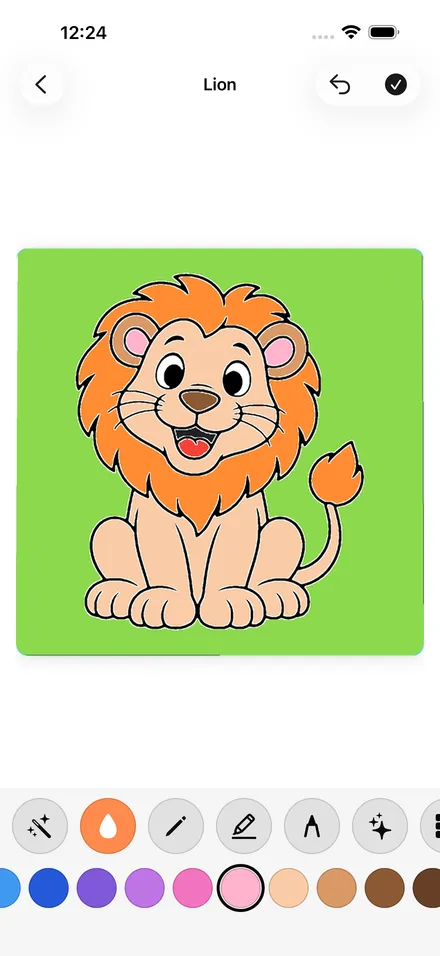
Gullu, the app behind this site, is designed for ages 3 to 7. Two things in it are useful at 3. Simple mode shows only the magic brush, which keeps color inside the lines of the area being colored, and tap to fill. And the first page of every land is free, 47 pages in all, so you can see whether your child likes it before deciding anything. Our page on a coloring app for 3-year-olds has the details.
An app does not replace crayons. A brush that keeps color inside the lines for the child is fun, but it is not practice at controlling a crayon. Our guide to coloring on a tablet vs paper compares the two.
FAQ
Should a 3-year-old be able to color?
A 3-year-old can usually scribble with some control and is learning to draw a circle. The CDC and AAP lists for this age describe scribbling and simple shapes, not neat coloring.
How well should a 3-year-old color?
Expect rough patches of color that go over the lines. Aiming at the picture and choosing colors on purpose are good signs at this age.
Are coloring books good for 3-year-olds?
The CDC's own tip for 3-year-olds suggests an activity box with paper, crayons and coloring books. Offer blank paper as well.
How long will a 3-year-old sit and color?
We found no official figure for age 3. The CDC lists 5 to 10 minutes of attention during activities as a milestone at 5 years, so a few minutes at 3 is no cause for worry. See how long kids can sit and color.
When should I talk to a doctor?
The CDC advises talking with your child's doctor if your child is not meeting one or more milestones for their age, has lost skills they once had, or you have other concerns.
Sources
- CDC, "Milestones by 30 Months": https://www.cdc.gov/act-early/milestones/30-months.html
- CDC, "Milestones by 3 Years": https://www.cdc.gov/act-early/milestones/3-years.html
- CDC, "Milestones by 4 Years": https://www.cdc.gov/act-early/milestones/4-years.html
- CDC, "Milestones by 5 Years": https://www.cdc.gov/act-early/milestones/5-years.html
- HealthyChildren.org (AAP), "Hand and Finger Skills of Your Preschooler": https://www.healthychildren.org/English/ages-stages/preschool/Pages/Hand-and-Finger-Skills-of-Your-Preschooler.aspx
- Zero to Three, "Learning to Write and Draw": https://www.zerotothree.org/resource/learning-to-write-and-draw/
- NAEYC, "Help Your Child Build Fine Motor Skills": https://www.naeyc.org/our-work/families/help-your-child-build-fine-motor-skills