Gullu
Are Coloring Pages Bad for Kids? What Teachers Mean and What the Evidence Says
Short answer: Coloring pages are not bad for kids. NAEYC's own articles say product-focused and process art both have value for young children, and the CDC suggests coloring books for 3-year-olds. The fair criticism is that a pre-drawn page leaves less room for a child's own ideas, so pair coloring pages with plenty of blank paper and open-ended art.
A note on our interest: this site publishes coloring pages, so we have a reason to like them. We have tried to report what each source says, including where it does not support us.
Why do some teachers say coloring pages are bad?
Because early childhood training favors "process art," where the child decides what to make, over art with a set result. In NAEYC's widely shared 2014 article, product-focused art is described as having instructions, a right and wrong way, and finished pieces that all look the same (NAEYC, Bongiorno).
A coloring page fits part of that description. Someone else drew the picture, and there is an implied right answer: stay inside, make the grass green. A teacher who wants children to plan and invent sees less of that on a pre-drawn sheet than on a blank one. That is a real point, and it is about what a page leaves out, not about harm.
What is process art, and how is it different?
Process art is open-ended art with no sample to copy and no right or wrong way to do it. NAEYC's 2014 article lists its marks: no step-by-step instructions, the child's own choice, and a result that is unique (NAEYC, Bongiorno). Product-focused art works toward a finished piece decided in advance.
| Process art | Product-focused art | Where a coloring page sits | |
|---|---|---|---|
| Who decides the picture | The child | The adult or a sample | The page decides the outline; the child decides colors and extras |
| Instructions | None | Steps to follow | None needed, unless an adult adds rules |
| Right or wrong way | No | Yes | Only if "stay in the lines" is enforced |
| Finished pieces | All different | All alike | Same outline, different colors |
| Typical materials | Paint, clay, collage, drawing tools | Craft kits, templates | Crayons, markers or pencils on a printed page |
The first three columns summarize NAEYC's lists. The last column is our reading, not NAEYC's.
What does NAEYC actually say about coloring pages?
Less than people assume. The 2014 NAEYC article that is usually quoted never mentions coloring pages, coloring books or coloring sheets. Its list of open-ended activities does include drawing with pencils, markers or crayons (NAEYC, Bongiorno). So crayons are firmly on the approved side. The pre-drawn outline is what the debate is about.
A later NAEYC article, from 2023, is more direct about balance. It says preschool art usually follows one of two approaches, "both of which have value for young children," and that teachers can use product-focused art to support fine motor and executive function skills (NAEYC, Fernando-Smith). That article also does not name coloring pages.
In short, NAEYC's articles argue for more open-ended art. We did not find a statement in them that coloring pages should be banned.
Is there research that coloring books harm creativity?
Not in anything we could open and read for this guide. None of the sources listed below cites a study showing that coloring books damage creativity, and we do not cite one either. The same caution applies in the other direction: none of them shows that coloring pages build creativity.
What the sources do support is narrower. Zero to Three says young children need no instructions for art and advises adults to comment on effort instead of the result (Zero to Three). That is advice about how adults behave around art. It applies to a coloring page as much as to a blank sheet.
When are coloring pages a good choice?
When the goal is hand practice, a calm activity or a shared theme. The CDC suggests giving 3-year-olds an activity box with paper, crayons and coloring books, and coloring alongside them (CDC, 3 years). The American Academy of Pediatrics lists coloring with crayons or chalk among quiet-time activities for 3-year-olds (AAP).
Coloring pages also suit:
- Children who freeze at a blank page. An outline gives them somewhere to start.
- Vocabulary and themes. A farm animals page invites talk about what a barn is for.
- Short waits. A page and three crayons travel well.
- Mixed ages. Siblings can share a theme at different levels of detail.
They are a weaker choice when every art session is a coloring page, or when an adult grades the result.
How do you mix coloring pages with free drawing?
Offer both, and let the child lead on the page as well. NAEYC's tips for process art include giving plenty of time, saying yes to children's ideas, and remembering that the art is theirs (NAEYC, Bongiorno). Those habits work with a printed outline too.
Ways to keep a coloring page open-ended:
- Put blank paper next to it. Let the child pick.
- Skip color rules. A blue lion is fine.
- Add to the page. Draw a background, weather, or what happens next.
- Turn it over. The back of a printed page is a blank sheet.
- Ask, do not judge. "Tell me about your picture" works better than "nice job staying in."
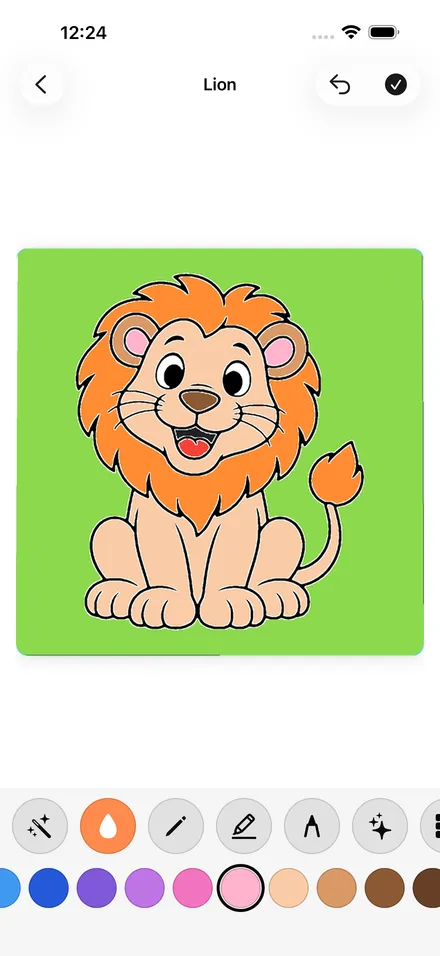
The same mix can exist on a screen. Gullu, on iPhone, iPad and Mac, has pre-drawn pages and also free draw on a blank sheet, so a child can do both in one sitting.
For more on what coloring does and does not practice, see benefits of coloring for kids. Teachers may want coloring activities for the preschool classroom.
Are coloring books good for 2- and 3-year-olds?
For most 2-year-olds, blank paper comes first. Zero to Three places random scribbling from about 15 months to 2½ years, when marks come from big arm movements (Zero to Three). The CDC's tip at 2 is crayons or finger paint on paper, and coloring books appear in its tips at 3 (CDC, 2 years).
So a coloring book will not hurt a 2-year-old, but they will mostly scribble across it. Around 3, simple outlines begin to mean something. Start with toddler pages or pages for 3-year-olds, with one big subject and thick lines.
FAQ
Are coloring pages developmentally appropriate?
The CDC and the AAP both include coloring among suggested activities for 3-year-olds. Early childhood educators ask that they not replace open-ended art. Used as one activity among several, they fit comfortably within both views.
Do coloring pages stop children from learning to draw?
We found no study showing that in the sources we could read. Children learn to draw by drawing, so make sure blank paper is always available alongside coloring pages.
Why does my child's preschool not use coloring sheets?
Many programs follow a process-art approach and prefer materials with no set result. That is a teaching choice, not a safety warning. You can still offer coloring pages at home.
Is it better to give blank paper or a coloring page?
Both. Blank paper invites the child's own ideas. A coloring page offers a ready subject and practice steering a crayon. NAEYC's 2023 article says both approaches to art have value.
Are coloring apps the same as coloring pages?
They are similar in idea but use different hand movements. See screen time and creative apps for how to weigh them.
Sources
- NAEYC (Bongiorno, L.), "How Process-Focused Art Experiences Support Preschoolers," Teaching Young Children, February/March 2014: https://www.naeyc.org/resources/pubs/tyc/feb2014/process-art-experiences
- NAEYC (Fernando-Smith, L.), "What Will We Make? Using Process Art to Spark Preschoolers' Development," Teaching Young Children, Winter 2023: https://www.naeyc.org/node/4824
- Zero to Three, "Learning to Write and Draw": https://www.zerotothree.org/resource/learning-to-write-and-draw/
- CDC, "Milestones by 2 Years": https://www.cdc.gov/act-early/milestones/2-years.html
- CDC, "Milestones by 3 Years": https://www.cdc.gov/act-early/milestones/3-years.html
- American Academy of Pediatrics, HealthyChildren.org, "Hand and Finger Skills of Your Preschooler": https://www.healthychildren.org/English/ages-stages/preschool/Pages/Hand-and-Finger-Skills-of-Your-Preschooler.aspx