Gullu
Road Trip Activities for Toddlers and Young Kids, Including Kids Who Get Car Sick
Short answer: For a 2- to 6-year-old on a long drive, plan a mix of looking-out-the-window games, songs and audio stories, a few soft toys, and a stop about every two hours, which is what the American Academy of Pediatrics suggests. If your child gets car sick, the AAP says to have them look at things outside the car, not at books or games, so save coloring and screens for the stops.
Which activities work in a car seat?
Ones a strapped-in child can do alone, with nothing sharp, heavy or easy to drop. The AAP's family travel tips suggest pointing out interesting sights along the way, and bringing soft, lightweight toys and favorite music for a sing-along (AAP).
The big question for each activity is whether the child has to look down. That matters for car sickness, which is covered below.
| Activity | Eyes down? | Fits a child who gets car sick? |
|---|---|---|
| I Spy and other looking games | No | Yes |
| Songs and sing-alongs | No | Yes |
| Audio stories | No | Yes |
| Talking games, such as "Would you rather" | No | Yes |
| Soft toys and puppets | A little | Often |
| Sticker books | Yes | Save for stops |
| Coloring pages on a clipboard | Yes | Save for stops |
| Picture books | Yes | Save for stops |
| Tablet or phone | Yes | Save for stops |
The first two columns are simple observation. The last column follows the AAP's car sickness advice. It is not a medical rule for every child.
A few practical points:
- Pack small and rotate. Bring out one new thing at a time, not the whole bag.
- Keep it within reach. A pouch on the seat in front saves you from turning around.
- Expect short bursts. The CDC says most 5-year-olds pay attention for 5 to 10 minutes during an activity (CDC), so six small activities go further than one big one.
Is coloring in the car a good idea?
For some children, yes. For a child who gets car sick, no.
NAEYC, the US early childhood association, suggests filling a backpack with writing tools and paper to take in the car or on errands (NAEYC). So drawing on the go is a recognized idea. If your child has never felt sick in a car, a clipboard, a few pages and a handful of crayons can fill a good stretch of road.
Things that make it easier:
- A clipboard or a hardcover book as a desk.
- Crayons, not markers. Crayons have no caps to lose and no ink to leak. Our guide to crayons, markers or pencils compares them.
- Three or four crayons, not the box. Fewer to drop.
- Easy pages with big shapes. A moving car is not the place for fine detail.
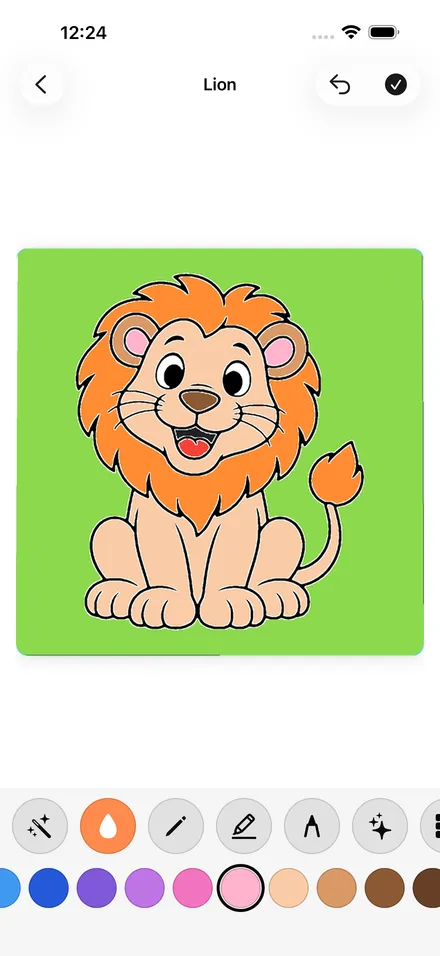
Here is the part that goes against our own interest as a coloring site and app. Coloring means looking down at a page, and so does a coloring app on a tablet. If your child gets car sick, neither is the right pick for the drive itself. Keep the pages and the tablet for rest stops, the hotel and the grandparents' table.
What if my child gets car sick?
Follow the AAP's steps, and ask your pediatrician before the trip if it has happened before.
The AAP explains that motion sickness happens when the brain gets conflicting signals from the inner ears, the eyes and the body. Its example is a child sitting so low in the back seat that she cannot see outside: her inner ear senses motion but her eyes do not (AAP). The CDC notes that motion sickness is more common in children from 2 to 12 years old (CDC).
What the AAP suggests:
- Talk, sing or listen to the radio to take attention away from the queasy feeling.
- Look outside. In its words: "Have her look at things outside the car, not at books or games."
- A light snack before the trip if your child has not eaten for three hours.
- Frequent short stops on a long trip.
- If symptoms start, stop as soon as it is safe and let your child get out and walk around.
- If that does not help, stop the car, take your child out of the car seat, and have them lie on their back for a few minutes with eyes closed. A cool cloth on the forehead can help.
The CDC adds distraction, such as listening to music, to its list of ways to prevent motion sickness without medicine.
About medicine. We name no medicines here. The AAP says to ask your pediatrician before using any, including those sold without a prescription, because they often have side effects. The CDC says some motion sickness medicines are not recommended for children, and to ask a healthcare professional about the right one and the dose.
When to tell the doctor. The AAP advises telling your pediatrician if your child has motion sickness symptoms when not moving, particularly with a headache, trouble hearing, seeing, walking or talking, or staring into space.
Never leave your child alone in the car at a stop, even for a minute. The AAP warns that the inside of a car can reach deadly temperatures within minutes.
Which games need no supplies?
Looking games and talking games. They keep eyes up and out of the window, which is also what the AAP advises for car sickness.
- I Spy. "I spy something red." The CDC lists I Spy among games that build memory and attention in 5-year-olds. With a 2- or 3-year-old, play it as "Can you see a truck?"
- Color cars. Each person picks a color and counts cars of that color. For a child still learning color words, see when kids learn colors.
- Count the things. Bridges, cows, buses. The CDC suggests counting simple everyday things with 4-year-olds (CDC).
- Animal sounds. One person makes the sound, the others guess.
- Story chain. Each person adds one sentence to a made-up story.
- Sing-along. The AAP's travel tips suggest bringing favorite music.
- Quiet game. Who can stay silent until the next bridge? Use it sparingly.
How should I plan stops and screen time?
Stop about every two hours, and decide the screen rules before you leave.
Stops. The AAP's travel tips say to plan a stop about every two hours to give yourself and your child a break. A child who tends to get car sick may need more frequent, shorter ones. Let children run at each stop. This is also the time for coloring, sticker books and snacks.
Screens. Official limits are short at these ages. The CDC's tips for ages 2 to 5 say to limit screen time to no more than 1 hour a day (CDC). The World Health Organization gives the same ceiling for ages 2 to 4 and adds that less is better (WHO). These sources do not make a special rule for travel days.
The AAP encourages each family to write its own media plan, with rules that fit its routines and values (AAP). For a road trip, that can mean deciding ahead of time when the tablet comes out, for how long, and what is on it. Telling your child the plan before you start makes the "off" moment easier.
Remember the car sickness point: a screen is an eyes-down activity. For more on young children and screens, see screen time and creative apps.
Is there a printable road trip pack?
We do not have a pack made only for road trips. You can build one in five minutes from the free pages on this site.
- Vehicles to spot. The Smiling Car is free on the car and truck coloring pages, and the Crane Truck is free on the truck coloring pages. More rides are on the transportation pages.
- Easy pages for the youngest. The toddler coloring pages have six free ones with big shapes.
- Everything at once. The first page of every Gullu land is free to print, 47 pages in one PDF.
Print six to ten pages per child, clip them to a board, and add a blank sheet or two for free drawing. Our guide to printing coloring pages has the printer settings.
Use the pack at stops and at your destination if your child gets car sick. Flying instead? See airplane activities for toddlers. For mealtimes on the way, see restaurant activities for kids.
FAQ
How often should you stop on a road trip with a toddler?
The AAP suggests planning a stop about every two hours. Children who get car sick may need frequent short stops.
Can toddlers get car sick?
Yes. The CDC says motion sickness is more common in children from 2 to 12 years old. The AAP says a young child may show it by becoming pale and restless, yawning and crying.
Does looking at a tablet make car sickness worse?
The AAP advises having a car-sick child look at things outside the car, not at books or games. A tablet is an eyes-down activity like a book.
What can a 2-year-old do in the car?
Looking games, songs, audio stories and soft toys. The AAP suggests pointing out interesting sights and bringing soft, lightweight toys and favorite music.
Should I give my child medicine for car sickness?
That is a question for your pediatrician. The AAP says to ask before using any motion sickness medicine, including ones sold without a prescription.
Sources
- HealthyChildren.org (AAP), "Car Sickness": https://www.healthychildren.org/English/health-issues/conditions/head-neck-nervous-system/Pages/Car-Sickness.aspx
- HealthyChildren.org (AAP), "Tips for Safe and Stress-Free Family Travel": https://www.healthychildren.org/English/safety-prevention/on-the-go/Pages/Travel-Safety-Tips.aspx
- HealthyChildren.org (AAP), "How to Make a Family Media Use Plan": https://www.healthychildren.org/English/family-life/Media/Pages/How-to-Make-a-Family-Media-Use-Plan.aspx
- CDC Travelers' Health, "Motion Sickness": https://wwwnc.cdc.gov/travel/page/motion-sickness
- CDC, "Milestones by 2 Years": https://www.cdc.gov/act-early/milestones/2-years.html
- CDC, "Milestones by 4 Years": https://www.cdc.gov/act-early/milestones/4-years.html
- CDC, "Milestones by 5 Years": https://www.cdc.gov/act-early/milestones/5-years.html
- World Health Organization, "To grow up healthy, children need to sit less and play more" (2019): https://www.who.int/news/item/24-04-2019-to-grow-up-healthy-children-need-to-sit-less-and-play-more
- NAEYC, "Support Writing at Home": https://www.naeyc.org/our-work/families/support-writing-home