Gullu
Does Coloring Help Handwriting and Fine Motor Skills? What the Studies Show
Short answer: Yes, coloring is a fine motor activity. NAEYC lists drawing and scribbling with crayons among the ways to build the small hand muscles used for writing. No study we read tested coloring against later handwriting directly, so treat it as useful practice, not a guarantee.
Is coloring a fine motor skill?
Yes. NAEYC describes fine motor skills as control of the small muscles in the hands, used for getting dressed, eating and writing, and its list of home activities includes drawing, scribbling or writing with crayons, pencils and markers (NAEYC). The American Academy of Pediatrics lists coloring with crayons or chalk among quiet activities that help a 3-year-old's hand abilities (AAP).
Coloring is fine motor, not gross motor. Gross motor skills use the large muscles, as in running or kicking a ball. A toddler's first scribbles do start with big arm movements from the shoulder, and control moves down to the fingers over time (Zero to Three).
Which hand skills does coloring practice, and at what age?
Coloring practices the crayon grip, steering a line toward an edge, and using two hands together. The CDC lists holding a crayon or pencil "between fingers and thumb (not a fist)" as a milestone most children reach by age 4 (CDC). The steps before and after look like this:
| Age | Hand skill most children show | Source |
|---|---|---|
| 18 months | Scribbles | CDC, 18 months |
| 2 years | Holds something in one hand while using the other | CDC, 2 years |
| 3 years | Can hold a crayon with thumb on one side and fingers on the other; copies a circle; traces a square | AAP |
| 4 years | Holds a crayon or pencil between fingers and thumb, not in a fist | CDC, 4 years |
| 4 to 5 years | Holds the paper with one hand and the pencil or crayon with the other | AAP |
| 5 years | Writes some letters in their name | CDC, 5 years |
Grip keeps changing through these years. A study of 320 children aged 3 to almost 7 recorded the grip each child used in a drawing task and a coloring task. In the youngest group 48% used a mature grip, and in the oldest group 90% did. The grips also differed between the drawing task and the coloring task (Schneck & Henderson, 1990).
Does coloring improve handwriting?
Nobody has shown that directly. We did not find a study that had one group of children color and then compared their handwriting with a group that did not. What the sources above support is narrower: coloring is practice with the same tool, the same grip and the same small muscles that writing uses.
One finding should take some pressure off. A study filmed 120 fourth-grade students writing and sorted their pencil grasps into six categories. The kind of grasp made no significant difference to how fast or how legibly they wrote (Schwellnus et al., 2012). So a "perfect" tripod grip is not the goal of coloring time. A comfortable grip that works is.
Do fine motor skills predict school results?
Yes, in two large studies, though neither tested coloring. An analysis of six long-term data sets found that fine motor skills measured around kindergarten entry were a strong predictor of later reading and math achievement, alongside attention and general knowledge (Grissmer et al., 2010).
A second study assessed 213 children aged 3 and 4 before kindergarten. Higher fine motor scores, specifically on a design copy task, predicted higher achievement at kindergarten entry and more improvement from fall to spring (Cameron et al., 2012). Design copy means copying shapes with a pencil.
Both studies show a link, not a cause. They do not prove that more coloring raises test scores. They do suggest that the eye-hand work in drawing and copying shapes is worth making time for.
How much coloring is enough?
There is no official number. None of the CDC, AAP or NAEYC pages cited here sets a daily amount of coloring. For a sense of scale, the CDC says most 5-year-olds can pay attention for 5 to 10 minutes during an activity (CDC). A few minutes at a time, most days, is realistic.
Follow your child's interest. One page finished happily is worth more than three pages finished under protest. Bold, easy pages with large areas suit a child who tires quickly, and our milestones by age guide shows which page styles fit each stage.
What else builds the same skills?
Plenty, and variety matters more than any one activity. NAEYC's list includes cutting with child-safe scissors, finger painting, playing with playdough and clay, doing puzzles, placing pegs in a board, building with small blocks, and everyday jobs like buttoning, zipping and pouring (NAEYC).
For 3-year-olds, the CDC suggests playdough to squish, press and pinch, and coloring and drawing lines and shapes together with your child (CDC). If your child does not like coloring, these activities work the same small muscles.
Does coloring on a tablet count?
The research is mixed, and none of it tested coloring apps specifically. In one study, 80 preschoolers followed a 24-week home program. The 40 who used manual play activities improved more in fine motor precision, integration and manual dexterity than the 40 who used a touch-screen tablet (Lin et al., 2017). A smaller cross-sectional study of 78 children aged 24 to 42 months found fine motor scores slightly favoring the children with tablet experience (Souto et al., 2020).
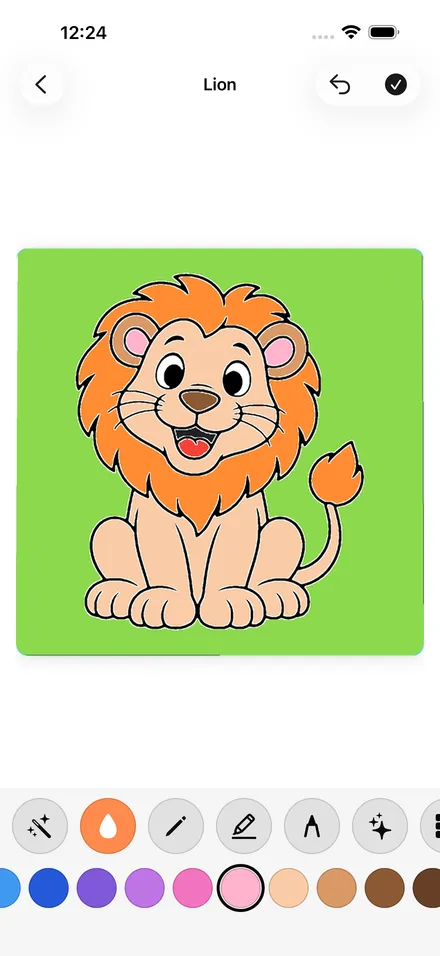
Our reading: screen coloring should add to crayons and paper, not replace them. A fingertip on glass is a different movement from holding a crayon. A stylus is held more like a pencil; Gullu, our coloring app for iPhone, iPad and Mac, works with Apple Pencil, though we make no claim that it improves handwriting. For how app time fits into the day, see our guide to screen time and creative apps.
FAQ
Is coloring a fine or gross motor skill?
Fine motor. It uses the small muscles of the hand and fingers. Very young children scribble with whole-arm movements at first, and control shifts to the fingers as they grow.
Does drawing improve handwriting?
Drawing and writing use the same tool and many of the same movements, and Zero to Three describes early art and early writing skills as one and the same for very young children. No study we read measured handwriting after a drawing program.
Does my child need a tripod grip before starting school?
Not necessarily. In a study of 120 fourth graders, the type of pencil grasp did not affect writing speed or legibility. If your child's grip looks painful or they avoid drawing altogether, ask their doctor or teacher.
What should I do if my 4-year-old still holds a crayon in a fist?
Milestones describe what most children do by an age, and children vary. If your child is not meeting one or more milestones, the CDC advises talking with your child's doctor and asking about developmental screening.
Where can I find coloring pages for practice?
Browse our printable coloring pages, where one page in each theme is free to print. The benefits of coloring guide covers what else coloring teaches. Alphabet pages pair well with early letter interest.
Sources
- NAEYC, "Help Your Child Build Fine Motor Skills": https://www.naeyc.org/our-work/families/help-your-child-build-fine-motor-skills
- HealthyChildren.org (AAP), "Hand and Finger Skills of Your Preschooler": https://www.healthychildren.org/English/ages-stages/preschool/Pages/Hand-and-Finger-Skills-of-Your-Preschooler.aspx
- Zero to Three, "Learning to Write and Draw": https://www.zerotothree.org/resource/learning-to-write-and-draw/
- CDC, "Important Milestones: Your Child By Eighteen Months": https://www.cdc.gov/act-early/milestones/18-months.html
- CDC, "Important Milestones: Your Child By Two Years": https://www.cdc.gov/act-early/milestones/2-years.html
- CDC, "Important Milestones: Your Child By Three Years": https://www.cdc.gov/act-early/milestones/3-years.html
- CDC, "Important Milestones: Your Child By Four Years": https://www.cdc.gov/act-early/milestones/4-years.html
- CDC, "Important Milestones: Your Child By Five Years": https://www.cdc.gov/act-early/milestones/5-years.html
- Schneck, C. M., & Henderson, A. (1990). Descriptive analysis of the developmental progression of grip position for pencil and crayon control in nondysfunctional children. American Journal of Occupational Therapy, 44(10), 893–900: https://pubmed.ncbi.nlm.nih.gov/2248351/
- Schwellnus, H., et al. (2012). Effect of pencil grasp on the speed and legibility of handwriting in children. American Journal of Occupational Therapy, 66(6), 718–726: https://pubmed.ncbi.nlm.nih.gov/23106992/
- Grissmer, D., et al. (2010). Fine motor skills and early comprehension of the world: two new school readiness indicators. Developmental Psychology, 46(5), 1008–1017: https://pubmed.ncbi.nlm.nih.gov/20822219/
- Cameron, C. E., et al. (2012). Fine motor skills and executive function both contribute to kindergarten achievement. Child Development, 83(4), 1229–1244: https://pubmed.ncbi.nlm.nih.gov/22537276/
- Lin, L.-Y., Cherng, R.-J., & Chen, Y.-J. (2017). Effect of touch screen tablet use on fine motor development of young children. Physical & Occupational Therapy in Pediatrics, 37(5), 457–467: https://pubmed.ncbi.nlm.nih.gov/28071977/
- Souto, P. H. S., et al. (2020). Tablet use in young children is associated with advanced fine motor skills. Journal of Motor Behavior, 52(2), 196–203: https://pubmed.ncbi.nlm.nih.gov/31007146/