Gullu
When Do Kids Color Inside the Lines? Ages, Tips and What Matters
Short answer: No official milestone list gives an age for coloring inside the lines. The CDC and the American Academy of Pediatrics describe the skills behind it, such as a finger grip and copying shapes, at ages 3 to 5, so most children get closer to the lines over those years. Staying inside them is a sign of growing hand control, not a test.
When do kids start coloring inside the lines?
There is no official age. None of the CDC milestone checklists from 18 months to 5 years mentions staying inside lines. What they list are the skills underneath it: drawing a circle when shown how at 3, and holding a crayon between fingers and thumb at 4 (CDC, 3 years; CDC, 4 years).
Put together, the sources describe a slow build from about 3 to 5 or 6:
| Age | What the sources describe | What that means for lines |
|---|---|---|
| 15 months to 2½ | Random scribbling from big shoulder movements, crayon in a fist (Zero to Three) | Lines on the page are ignored. That is expected. |
| 2 to 3 | Controlled scribbling: repeated circles and lines as finger control improves (Zero to Three) | Color lands near the picture, not inside it. |
| 3 | Draws a circle when shown (CDC); can trace a square and copy a circle (AAP) | May fill one big shape roughly. |
| 4 | Holds a crayon between fingers and thumb, not a fist (CDC) | Staying in large areas starts to be possible. |
| 4 to 5 | Draws with more care, plans a picture, traces and copies patterns such as stars or diamonds (AAP) | Smaller areas, slower and more deliberate strokes. |
Zero to Three notes that its age ranges are approximate, because children move through these stages at different speeds.
Is it normal for a 4-year-old not to color in the lines?
Yes. The CDC's 4-year checklist is about how a child holds the crayon, between fingers and thumb, and whether they can draw a person with three or more body parts. Neatness is not on it (CDC, 4 years). A 4-year-old who colors across the lines is doing what many 4-year-olds do.
Grip is still changing at this age. In a study of 320 typically developing children aged 3 to almost 7, observed during a drawing task and a coloring task, 48% of the youngest group used a mature grip, compared with 90% of the oldest (Schneck & Henderson, 1990). Until the grip settles, fine steering near an edge is hard work.
Should a 5-year-old color in the lines?
Many can for large shapes, but no official list requires it. At 5, the CDC lists writing some letters of their name and paying attention for 5 to 10 minutes during an activity such as arts and crafts (CDC, 5 years). Those are the skills a kindergarten teacher will lean on.
A 5-year-old may stay inside a big balloon and still scribble over a small flower. That gap is about the size of the space, not about effort. Offer pages that match what their hand can do today, such as our preschool coloring pages.
Why do kids color outside the lines?
Mostly because their hands are not ready yet. Zero to Three explains that early scribbles come from large shoulder movements with the crayon held in a fist, and that control of the hand and fingers arrives gradually between about 2 and 3 (Zero to Three). Lines need small finger movements, which come later.
There are everyday reasons too. A child may be more interested in the color than the picture, may be in a hurry to get to the next page, or may have decided the dog should be standing in a purple storm. None of these is a problem to fix.
How do you teach a child to color inside the lines?
Do it side by side, in small steps, and without correcting. The CDC's tip for 3-year-olds is to color and draw lines and shapes together with your child (CDC, 3 years). For younger children it suggests drawing a straight line to see if they copy it, then a circle (CDC, 30 months).
Practical ideas that fit that advice:
- Start with one big shape. A single circle or apple is easier than a busy scene.
- Trace the edge first. Go around the inside of the outline together, then fill the middle.
- Slow down near the edge. Show big strokes in the middle and small ones at the border.
- Keep it short. Stop while it is still fun.
- Build the hand elsewhere. The CDC notes that squishing and pinching play dough builds hand and finger muscles for writing, buttoning and cutting (CDC, 3 years).
Which coloring pages make it easier?
Pages with thick outlines, large areas and few sections. No official body sets a rule for this, so treat it as common sense: a wide line gives a wobbly crayon more room for error, and a big space forgives a big movement. Detailed scenes can wait until grip and patience grow.
Try bold and easy pages or toddler pages first, then move up. You can also try a sample in the browser at Color Online.
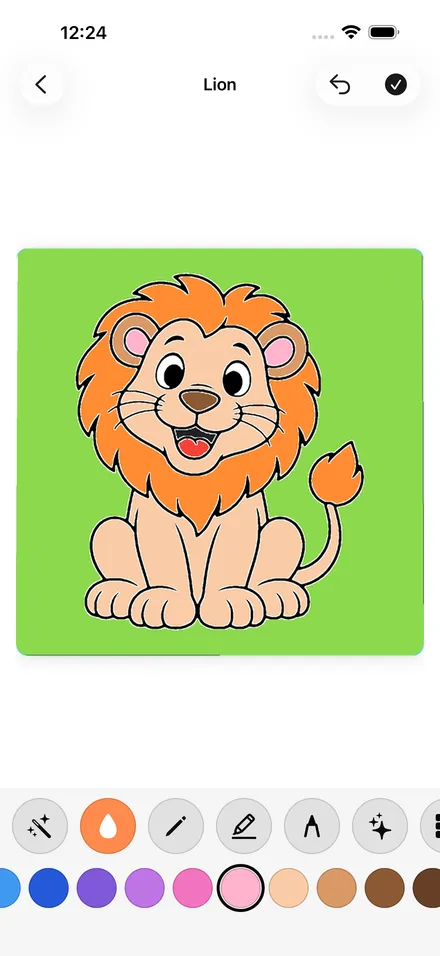
Some coloring apps hold the color inside the shape for the child. Gullu, on iPhone, iPad and Mac, has a magic brush that keeps color inside the lines. That helps a young child finish a page they are proud of, but it is not the same as practicing crayon control, so keep paper and crayons around too.
Does coloring inside the lines matter?
Less than it seems. Zero to Three advises parents to "notice the process, not just the product," and to comment on effort instead of results (Zero to Three). Staying in the lines shows that hand control is growing. It is one sign among many, and it tends to follow practice instead of reminders.
NAEYC's description of product-focused art lists children asking whether they are doing it right as one of its marks (NAEYC). If coloring starts to sound like that at your table, ease off the lines and mix in blank paper. Our guide to the benefits of coloring covers that balance.
When should I ask a doctor or teacher?
Coloring outside the lines is not, on its own, a reason to worry. The CDC's advice is broader: if your child is not meeting one or more milestones for their age, has lost skills they once had, or you have other concerns, talk with your child's doctor and ask about developmental screening (CDC milestones).
For hand skills, the listed milestones are scribbling by 18 months, drawing a circle when shown by 3, and a finger-and-thumb crayon hold by 4. A preschool or kindergarten teacher sees many children the same age and can tell you how your child's coloring compares in class.
FAQ
Can a 3-year-old color inside the lines?
Some can stay roughly inside one large shape, and many cannot yet. At 3, the CDC milestone is drawing a circle when shown how. Fine control near an edge usually comes later, as the grip moves from fist to fingers.
Do crayons, markers or pencils make it easier?
No source we read compares them for staying in the lines. A tool that fits your child's hand and makes a clear mark without hard pressing is a sensible choice. See crayons, markers or pencils by age.
Should I correct my child when they go over the line?
Zero to Three suggests commenting on effort and asking about the picture instead. Showing how you slow down near an edge works better than pointing out misses.
Is coloring outside the lines a sign of creativity?
There is no evidence either way in the sources below. It is usually a sign of age and hand control. Creative choices show up in what children pick, add and explain.
Where does this fit with other coloring milestones?
See when kids start coloring for scribbling, grip and drawing from ages 1 to 7.
Sources
- CDC, "CDC's Developmental Milestones": https://www.cdc.gov/act-early/milestones/index.html
- CDC, "Milestones by 30 Months": https://www.cdc.gov/act-early/milestones/30-months.html
- CDC, "Milestones by 3 Years": https://www.cdc.gov/act-early/milestones/3-years.html
- CDC, "Milestones by 4 Years": https://www.cdc.gov/act-early/milestones/4-years.html
- CDC, "Milestones by 5 Years": https://www.cdc.gov/act-early/milestones/5-years.html
- American Academy of Pediatrics, HealthyChildren.org, "Hand and Finger Skills of Your Preschooler": https://www.healthychildren.org/English/ages-stages/preschool/Pages/Hand-and-Finger-Skills-of-Your-Preschooler.aspx
- Zero to Three, "Learning to Write and Draw": https://www.zerotothree.org/resource/learning-to-write-and-draw/
- NAEYC (Bongiorno, L.), "How Process-Focused Art Experiences Support Preschoolers": https://www.naeyc.org/resources/pubs/tyc/feb2014/process-art-experiences
- Schneck, C. M., & Henderson, A. (1990). Descriptive analysis of the developmental progression of grip position for pencil and crayon control in nondysfunctional children. American Journal of Occupational Therapy, 44(10), 893–900: https://pubmed.ncbi.nlm.nih.gov/2248351/