Gullu
Fine Motor Activities for 3- to 5-Year-Olds: 15 Ideas With Things You Already Have
Short answer: Fine motor skills are the small hand movements children use to dress, eat, draw and write. NAEYC, the US early childhood association, says everyday jobs such as pouring, buttoning, cutting with child-safe scissors, play dough and drawing with crayons all build them. No special equipment is needed, and a few minutes inside normal routines is enough.
What are fine motor skills?
They are skills that need control of the small muscles in the hands. NAEYC gives getting dressed, eating and writing as everyday examples, and says practice builds the muscle strength and coordination children later need for a pencil, a computer mouse or a musical instrument (NAEYC).
Understood, a nonprofit for families of children who learn differently, defines them as "the ability to make movements using the small muscles in our hands and wrists." It adds that they build on gross motor skills, the bigger movements used for running and jumping (Understood).
So a child stacking blocks, zipping a jacket or peeling a sticker is doing the same kind of work as a child coloring.
What should a 3-, 4- and 5-year-old's hands be able to do?
The CDC lists what most children can do by each age, and the American Academy of Pediatrics (AAP) describes typical hand skills in more detail. Both are US bodies, and both describe a range, not a test.
| Age | What the CDC lists | What the AAP describes |
|---|---|---|
| 3 years | Strings items such as large beads or macaroni. Puts on some clothes alone. Uses a fork. Draws a circle when shown how | Holds a crayon like an adult, thumb on one side and fingers on the other. Copies a circle, traces a square. Pours from a pitcher with two hands |
| 4 years | Holds a crayon or pencil between fingers and thumb, not a fist. Unbuttons some buttons. Serves food or pours water with supervision | Between 4 and 5: copies shapes, draws people with faces, cuts with safety scissors, dresses with little help |
| 5 years | Buttons some buttons. Writes some letters in their name | Hand coordination is close to fully developed. May tie shoes |
Sources: CDC, 3 years, CDC, 4 years, CDC, 5 years and AAP, preschoolers.
The CDC describes its milestones as things most children can do by that age. Many get there earlier, and children do not learn every skill in the same order.
What are 15 fine motor activities with things already at home?
Each one below comes from a list by NAEYC, the CDC or the AAP. None needs a kit.
In the kitchen
- Set the table. Carrying and placing forks, spoons and cups (NAEYC).
- Pour. Juice or water into a cup, with you nearby. The CDC lists pouring water with supervision by 4.
- Help with a meal. Stir, shake, mix, and wipe the table with a sponge (NAEYC).
- Open and close containers. Lids, boxes and snack tubs (NAEYC).
Getting dressed
- Buttons, zips, snaps and buckles. NAEYC lists all four. Start with big buttons on a shirt lying flat on the table.
- Velcro tabs. Shoes are a good first win (NAEYC).
At the table
- Play dough. Squish, press, pinch and roll balls. The CDC says this builds hand and finger muscles for writing, buttoning and cutting (CDC, 3 years).
- String large beads or dry pasta on a shoelace. This is a CDC milestone at 3 and an AAP activity.
- Puzzles with large pieces (NAEYC and AAP).
- Small blocks. Towers, bridges and walls (NAEYC and AAP).
- Pegs in a board (NAEYC and AAP).
- Finger paint or a paintbrush on big paper (NAEYC).
- Draw, scribble or write with crayons, pencils and markers (NAEYC).
- Cut and paste with child-safe scissors and glue (NAEYC, and the AAP for ages 4 to 5).
- Board games, card games and puppets. Picking up cards and moving pieces counts too (NAEYC).
You do not need all 15. Two or three that fit into the day you already have are plenty. Small parts such as beads and pegs need an adult close by, since younger children may still put things in their mouths.
Which coloring and drawing activities help most?
No source we read ranks them, so we will not either. What the sources do describe is a path, and you can follow it.
- Age 3: the CDC suggests an "activity box" with paper, crayons and coloring books, and coloring and drawing lines and shapes together.
- Ages 4 to 5: the AAP lists writing and drawing, tracing or copying shapes such as stars and diamonds, painting and clay.
- By 5: the CDC suggests keeping a box of crayons, paper, paint, child scissors and glue for creative play.
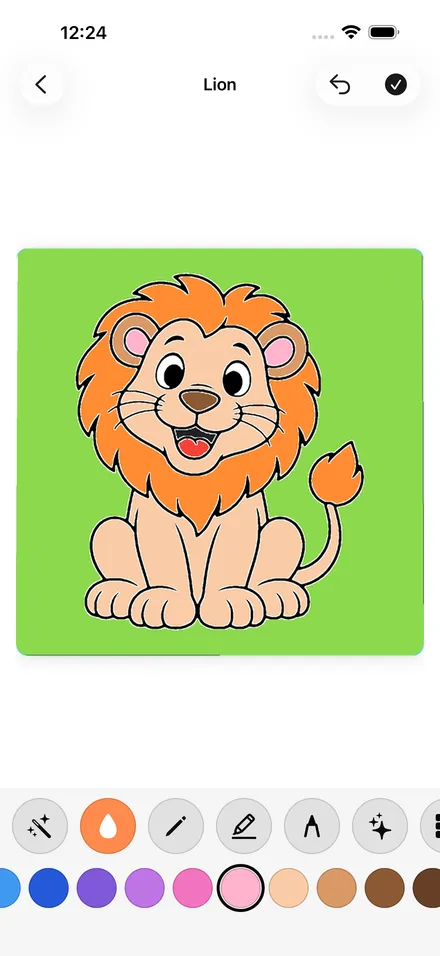
A coloring page is one more reason to hold a crayon for a few minutes. Pick pictures with big, simple areas for younger hands, such as the preschool pages or bold and easy pages. Of the 100 free printables on this site, many suit this age. Blank paper matters just as much, because free drawing lets a child plan their own lines.
If you wonder how the grip itself changes, see pencil grip by age. For the shapes that come before letters, see pre-writing strokes.
Do fine motor skills matter for school?
Two large studies link them to later school results, with limits worth knowing.
An analysis of long-running data sets found that fine motor skills measured around kindergarten entry were a strong predictor of later achievement, alongside attention and general knowledge of the world (Grissmer et al., 2010).
A second study assessed 213 children at ages 3 and 4. Higher fine motor skill, and in particular a task the authors call design copy, predicted higher achievement at kindergarten entry and more improvement from fall to spring (Cameron et al., 2012).
Both studies show a link. Neither tested whether extra practice at home raises school results, so we make no promise of that kind. They are a good reason to give hands plenty to do, and no reason to drill.
What fine motor activities work in a kindergarten classroom?
The same ones, set out so that many children can use them at once. This part is our practical reading of the NAEYC list, not an official classroom plan.
- A play dough table with craft sticks and stamps as tools.
- A cutting tray with paper strips, child-safe scissors and glue.
- A drawing and writing shelf with crayons, pencils, markers and scrap paper.
- A puzzle and peg corner.
- Real jobs. Handing out cups, wiping tables, zipping their own coats.
Rotate one tray a week so there is always something new. For more ideas built around coloring, see coloring activities for the preschool classroom.
When do kids use scissors?
Usually in the preschool years, with child-safe scissors and an adult beside them. The AAP lists cutting with safety scissors among activities for 4- and 5-year-olds, and the CDC suggests child scissors in the art box by 5. NAEYC lists cutting with child-safe scissors as a fine motor activity without giving an age.
The sources we read do not give an "age by cut" chart, so we do not repeat the ones found online. An occupational therapy worksheet from an NHS trust in England gives practical first steps instead (West Suffolk NHS Foundation Trust):
- Start with snipping. Thin strips of paper, play dough sausages or drinking straws.
- Keep the paper small. About a quarter of a letter-size sheet.
- Thumbs on top. For both the scissor hand and the paper hand.
- Let the child hold the paper. If that is hard, tape one end to the table.
- Use tongs or tweezers as a warm-up for the same hand motion.
- Give left-handed children left-handed scissors.
FAQ
How can I improve my 4-year-old's fine motor skills?
Give their hands real jobs every day. NAEYC lists dressing, pouring, play dough, puzzles, scissors and drawing. Keep it short and playful, and offer a range of activities, which is what the AAP suggests at this age.
How long should a preschooler do fine motor activities each day?
No source we read sets a number of minutes. The activities above happen inside meals, dressing and play, so most children get practice without a special session.
Is coloring a fine motor activity?
Yes. NAEYC lists drawing, scribbling or writing with crayons, pencils and markers among its fine motor activities. See benefits of coloring for kids for what else it practices.
Does a coloring app count as fine motor practice?
Swiping and tapping use the hands, but they are different from gripping and pressing a crayon. Treat an app as a different activity, not a replacement. See coloring on a tablet vs paper.
When should I talk to a doctor about my child's hand skills?
The CDC advises talking with your child's doctor and asking about developmental screening if your child is not meeting one or more milestones, has lost skills they once had, or you have other concerns. You know your child, so there is no need to wait.
Sources
- NAEYC, "Help Your Child Build Fine Motor Skills": https://www.naeyc.org/our-work/families/help-your-child-build-fine-motor-skills
- Understood, "What are fine motor skills?": https://www.understood.org/en/articles/all-about-fine-motor-skills
- CDC, "Milestones by 3 Years": https://www.cdc.gov/act-early/milestones/3-years.html
- CDC, "Milestones by 4 Years": https://www.cdc.gov/act-early/milestones/4-years.html
- CDC, "Milestones by 5 Years": https://www.cdc.gov/act-early/milestones/5-years.html
- American Academy of Pediatrics, HealthyChildren.org, "Hand and Finger Skills of Your Preschooler": https://www.healthychildren.org/English/ages-stages/preschool/Pages/Hand-and-Finger-Skills-of-Your-Preschooler.aspx
- Grissmer, D., Grimm, K. J., Aiyer, S. M., Murrah, W. M., & Steele, J. S. (2010). Fine motor skills and early comprehension of the world: two new school readiness indicators. Developmental Psychology, 46(5), 1008–1017: https://pubmed.ncbi.nlm.nih.gov/20822219/
- Cameron, C. E., Brock, L. L., Murrah, W. M., Bell, L. H., Worzalla, S. L., Grissmer, D., & Morrison, F. J. (2012). Fine motor skills and executive function both contribute to kindergarten achievement. Child Development, 83(4), 1229–1244: https://pubmed.ncbi.nlm.nih.gov/22537276/
- West Suffolk NHS Foundation Trust, Paediatric Occupational Therapy Service, "Worksheet E: Scissor Skills and Using a Ruler": https://www.wsh.nhs.uk/CMS-Documents/Services/Integrated-Community-Paediatric-Services-OT/e.-Scissor-Skills-and-Using-a-Ruler.pdf