Gullu
How Long Can a 3- to 5-Year-Old Sit and Color? Normal Attention by Age
Short answer: The CDC lists paying attention for 5 to 10 minutes during activities such as arts and crafts as a milestone at age 5, and gives no attention figure for ages 3 or 4, so a few minutes of coloring at 3 is nothing unusual. A child who colors for a minute and walks away is usually acting their age. Short, relaxed sessions are a kinder goal than pushing for longer ones.
What is a normal attention span at 3, 4 and 5?
Shorter than most charts online suggest, and less exact. The one clear official figure we found is from the CDC. Its checklist for age 5 says a child "pays attention for 5 to 10 minutes during activities," with story time and arts and crafts as examples, and adds: "Screen time does not count" (CDC, 5 years).
For ages 3 and 4, the CDC checklists list no attention milestone at all. The American Academy of Pediatrics (AAP) describes attention at those ages in words, not minutes.
| Age | What official sources say about attention | What that means for coloring |
|---|---|---|
| 3 | No minutes given. The AAP says a 3-year-old is still "developing both the muscular control and the concentration" for precise hand movements (AAP) | A few minutes is fine. Several short visits to the table are normal |
| 4 | No minutes given. The AAP says 4-year-olds use their hands "with far more care and attention when drawing" | Longer and more careful than at 3, with wide differences between children |
| 5 | Pays attention for 5 to 10 minutes during an activity such as arts and crafts (CDC) | One page, or a good part of one, in a sitting |
The right-hand column is our reading of those sources. It is not an official chart.
About the "2 to 3 minutes per year of age" rule. You will see it on many websites, often written as a chart. We could not find it in any CDC, AAP or World Health Organization page we read, so we do not repeat it as fact. If your child does not match a chart like that, the chart may be the problem.
The AAP's description of a 3-year-old's listening is a helpful picture. A child this age pays close attention to your answers as long as they are "simple and to the point." Give a long explanation and you will see her "turn her attention to more entertaining matters, such as a toy across the room" (AAP, cognitive development). Coloring works the same way.
What should a 3-year-old's coloring look like?
Like scribbles, lines and a few rough shapes. Neat filling-in comes later. Zero to Three describes overlapping stages: controlled scribbling from about 2 to 3 years, lines and patterns from about 2½ to 3½, and pictures of objects or people from about 3 to 5 (Zero to Three).
| Age | What the sources list |
|---|---|
| 3 | Draws a circle when shown how (CDC, 3 years); can trace a square, copy a circle or scribble freely; may decide a scribble looks like a dog after making it (AAP) |
| 3 to 4 | Draws a person with a head and one other body part; correctly names some colors (AAP, 3 to 4 years) |
| 4 | Draws a person with three or more body parts; names a few colors; holds a crayon between fingers and thumb (CDC, 4 years); decides in advance what to draw (AAP) |
| 4 to 5 | Copies a triangle and other shapes; correctly names at least four colors (AAP, 4 to 5 years) |
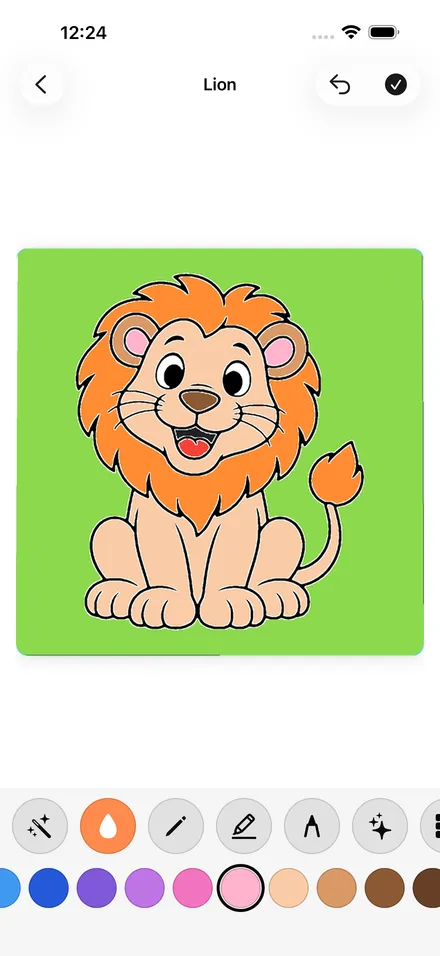
None of these lists mentions staying inside the lines. A 3-year-old who covers a lion in one big purple scribble is doing what 3-year-olds do. See when kids color inside the lines and coloring for 3-year-olds.
Why does my child color for one minute and leave?
Usually because one minute was enough for them. Some common reasons, with what the sources say:
- Age. The only official figure is 5 to 10 minutes, and that is at 5.
- They need to move. The World Health Organization says children under 5 should not "sit for extended periods of time" and need plenty of active play through the day (WHO). Leaving the table is not a failure.
- Tiredness. The AAP lists difficulty concentrating among the effects of not getting enough sleep (AAP, sleep). The CDC says children of 4 and 5 need 10 to 13 hours of sleep a day, including naps.
- The task is someone else's idea. The CDC encourages "free play," where a child follows their own interests (CDC, 30 months). A page they chose may hold them longer than a page they were handed.
- The page or tool is hard. Small details and faint crayons can frustrate small hands. Try bold and easy pages and see crayons, markers or pencils.
- They just do not love coloring. Some children prefer blocks, running or stories. See what to do if your child does not like coloring.
A child who leaves and returns three times has still colored three times.
Why does my child rush or scribble over the page?
Because for young children the doing matters more than the result. Zero to Three describes early scribblers as enjoying the feedback from their senses: how the crayon feels, the marks appearing on the page. Its advice to adults is to "notice the process, not just the product."
Scribbling over a picture is also a normal stage and not carelessness. Zero to Three places scribbling stages up to about age 3, and the AAP still lists "scribble freely" as something a 3-year-old does. Planning a picture before starting comes around 4, according to the AAP.
Rushing can also mean your child wants to get to the next page or to show you. There is no need to correct speed.
How do you stretch focus gently?
Make coloring easy to start and pleasant to stay with. These ideas are drawn from official tips for these ages:
- Sit down and color too. The CDC's tip for 3-year-olds is to give an activity box with paper, crayons and coloring books, and to color and draw with your child.
- Let them choose. Offer two or three pages and let your child pick. Themes they love help: dinosaurs, unicorns, farm animals.
- Talk about the picture. The CDC suggests asking 5-year-olds what they are doing and following up with "Why?" and "How?"
- Skip the instructions. Zero to Three: "No need for instructions."
- Show the result. Both the CDC and Zero to Three suggest displaying children's art.
- Play attention games at other times. For 5-year-olds, the CDC suggests card games, Tic Tac Toe, I Spy and Hot and Cold to build attention and memory.
- Protect sleep. A regular bedtime routine and 10 to 13 hours of sleep for ages 3 to 5 support concentration (CDC, WHO, AAP).
Do not use a timer to make a child stay. The aim is a child who likes coloring, not one who lasts a set number of minutes.
A note on screens: the CDC does not count screen time toward its attention milestone, so time spent watching a show tells you little about attention for other activities. Coloring on a tablet is a different activity from coloring on paper. See coloring on a tablet vs paper.
When is short attention worth mentioning to a doctor?
When it is extreme for your child's age and shows up in everything, not just coloring. The AAP's list for ages 4 to 5 suggests talking with your pediatrician if a child "is easily distracted and unable to concentrate on any single activity for more than five minutes." The same list includes a child who "seems uncomfortable holding a crayon" or does not engage in a variety of activities.
Notice the wording: any single activity. A 4-year-old who leaves coloring after two minutes but stays with blocks or a story for much longer is not who that line describes.
The AAP also says each child develops in their own way, and not to be alarmed if development takes a slightly different course. Short attention for coloring is not, by itself, a sign of any condition, and this page cannot diagnose one. If you are worried, write down what you see over a week or two and take it to your child's doctor. A preschool teacher's view is useful as well.
FAQ
How long should a 4-year-old be able to color?
No official source gives minutes for age 4. The CDC figure of 5 to 10 minutes on one activity is listed at age 5, so less than that at 4 is not a concern by itself.
Is the "minutes per year of age" attention rule true?
We could not find it in the CDC, AAP or WHO pages we read. Treat charts based on it as rough guesses.
Should I make my child finish the page?
No source here suggests it. Zero to Three advises noticing the process, not the product. An unfinished page can wait for tomorrow.
Does coloring improve attention?
The sources on this page do not say that. For what research does and does not show, see benefits of coloring for kids.
My child focuses on a tablet for ages but not on paper. Why?
The CDC leaves screen time out of its attention milestone, so it is not a fair comparison. The AAP notes that many digital platforms are designed to keep users engaged for as long as possible (AAP).
What about quiet time?
Several short activities work better than one long one. See quiet time activities and coloring milestones by age.
Sources
- CDC, "Milestones by 30 Months": https://www.cdc.gov/act-early/milestones/30-months.html
- CDC, "Milestones by 3 Years": https://www.cdc.gov/act-early/milestones/3-years.html
- CDC, "Milestones by 4 Years": https://www.cdc.gov/act-early/milestones/4-years.html
- CDC, "Milestones by 5 Years": https://www.cdc.gov/act-early/milestones/5-years.html
- American Academy of Pediatrics, HealthyChildren.org, "Hand and Finger Skills of Your Preschooler": https://www.healthychildren.org/English/ages-stages/preschool/Pages/Hand-and-Finger-Skills-of-Your-Preschooler.aspx
- American Academy of Pediatrics, HealthyChildren.org, "Cognitive Development in Preschool Children": https://www.healthychildren.org/English/ages-stages/preschool/Pages/Cognitive-Development-In-Preschool-Children.aspx
- American Academy of Pediatrics, HealthyChildren.org, "Developmental Milestones: 3 to 4 Year Olds": https://www.healthychildren.org/English/ages-stages/preschool/Pages/Developmental-Milestones-3-to-4-Year-Olds.aspx
- American Academy of Pediatrics, HealthyChildren.org, "Developmental Milestones: 4 to 5 Year Olds": https://www.healthychildren.org/English/ages-stages/preschool/Pages/Developmental-Milestones-4-to-5-Year-Olds.aspx
- American Academy of Pediatrics, HealthyChildren.org, "Healthy Sleep Habits: How Many Hours Does Your Child Need?": https://www.healthychildren.org/English/healthy-living/sleep/Pages/healthy-sleep-habits-how-many-hours-does-your-child-need.aspx
- American Academy of Pediatrics, HealthyChildren.org, "Helping Kids Thrive in a Digital World: AAP Policy Explained": https://www.healthychildren.org/English/family-life/Media/Pages/helping-kids-thrive-in-a-digital-world-AAP-policy-explained.aspx
- Zero to Three, "Learning to Write and Draw": https://www.zerotothree.org/resource/learning-to-write-and-draw/
- World Health Organization, "To grow up healthy, children need to sit less and play more" (2019): https://www.who.int/news/item/24-04-2019-to-grow-up-healthy-children-need-to-sit-less-and-play-more