Gullu
My Child Doesn't Like Coloring: Is That OK, and What Can I Try?
Short answer: Yes, it is OK. Liking coloring is not on any CDC milestone checklist, and the American Academy of Pediatrics advises offering a broad range of activities and letting children choose what they enjoy. The hand skills that coloring practices can also come from play dough, scissors, puzzles, blocks and everyday tasks.
Is it normal for a child not to like coloring?
Yes. The CDC checklists from 18 months to 5 years list skills, such as scribbling at 18 months and a finger-and-thumb crayon hold at 4. None of them lists enjoying coloring (CDC milestones). A child can meet every hand milestone and still prefer blocks, climbing or pretend play.
The American Academy of Pediatrics makes the same point about preschoolers in general. It advises parents not to push a child in one direction, but to offer a broad range of activities and let the child pick what they enjoy most (AAP).
Why do some kids avoid coloring?
Usually for ordinary reasons: it is hard for their hands right now, the material feels unpleasant, or something else is more fun. Zero to Three notes that some young children find the feel of art materials overwhelming and avoid activities such as finger painting, and suggests bringing those back gradually (Zero to Three).
Other common reasons parents and teachers see:
- It is tiring. A fist grip and big arm movements make filling a shape slow work for a 2- or 3-year-old.
- The page is too detailed. Small spaces frustrate a hand that is not ready for them.
- They feel judged. A child who hears a lot about staying in the lines may decide not to try.
- They would rather move. Sitting still is a skill that grows with age.
- The subject is dull to them. A child who loves trucks may ignore a flower.
These are observations, not diagnoses. Disliking coloring does not, by itself, point to any condition.
What can I try if my toddler won't color?
Lower the demand and change the setup before giving up on it. The CDC's tips for 30 months suggest letting a child "draw" with crayons on paper, in shaving cream on a tray, or with chalk on a sidewalk (CDC, 30 months). All three count as mark-making, and two of them need no crayon.
More ideas:
- Follow the interest. Print one page of what they love: dinosaurs, trucks or unicorns.
- Go big and simple. Try bold and easy pages with one large shape.
- Change the tool. Chalk, a paintbrush with water, or a marker that glides may feel better than a waxy crayon.
- Color next to them. The CDC suggests coloring and drawing lines and shapes together at 3 (CDC, 3 years).
- Keep it to a few minutes. Stop before it becomes a chore.
- Drop the rules. Zero to Three advises commenting on effort instead of on whether trees are green.
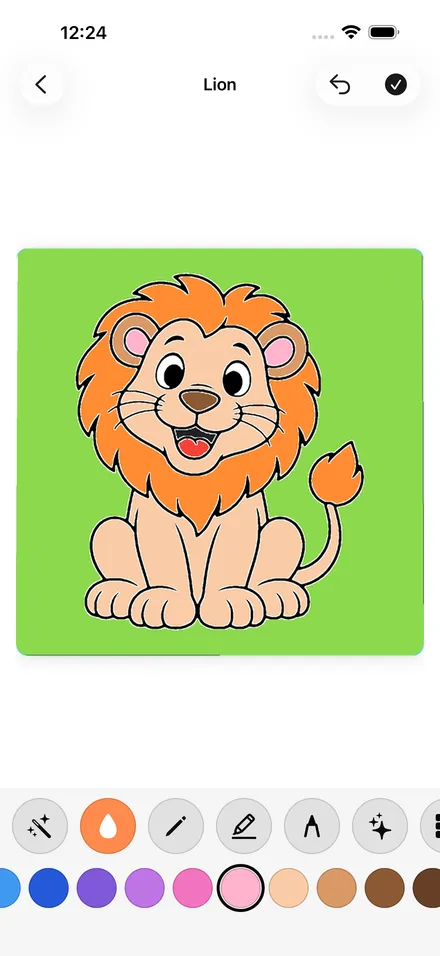
Some children who avoid crayons enjoy coloring on a screen, where less hand effort is needed. In Gullu, on iPhone, iPad and Mac, tap to fill colors a whole area with one tap. That can make a picture feel doable, though it is a different movement from using a crayon.
What builds the same hand skills without coloring?
Almost any activity that uses the small muscles of the hand. NAEYC's family guide lists 18, from setting the table to playing with puppets, and only one of them involves crayons (NAEYC). The CDC adds that squishing and pinching play dough builds hand and finger muscles for writing, buttoning and cutting (CDC, 3 years).
| What coloring practices | Other ways to practice it (from NAEYC's list) |
|---|---|
| Hand and finger strength | Play dough and clay, wiping a table with a sponge, stirring and mixing food |
| Finger control | Buttons, zippers and snaps, pegs in a board, small blocks |
| Holding a tool | Paintbrush, spoon and fork, child-safe scissors |
| Using two hands together | Opening and closing lids, pouring into a cup, puzzles |
| Making marks | Finger paint, a paintbrush, pencils or markers instead of crayons |
A NAEYC article about a preschool classroom describes a boy who avoided paper-and-pencil activities but worked happily with modeling clay, which helped strengthen his fine motor skills (NAEYC, Fernando-Smith). It is one classroom story, not a study, but it matches what many teachers do.
Do they need coloring before kindergarten?
They need the hand skills, not the hobby. By 5, the CDC lists writing some letters of their name, buttoning some buttons, and paying attention for 5 to 10 minutes during an activity (CDC, 5 years). By 4, it lists holding a crayon or pencil between fingers and thumb (CDC, 4 years).
A child can reach those through drawing, play dough, building and dressing themselves. Coloring is a convenient way to practice, and classrooms use it often, so a little comfort with crayons helps. It does not have to be a favorite. For what classrooms do with coloring, see coloring activities for the preschool classroom.
When is it worth asking a doctor or teacher?
When your concern is about skills, not taste. The CDC advises acting early if a child is not meeting one or more milestones for their age, has lost skills they once had, or you have other concerns: talk with your child's doctor and ask about developmental screening (CDC milestones).
For hand skills, the CDC checklists include:
- 18 months: scribbles
- 3 years: draws a circle when shown how; strings large beads
- 4 years: holds a crayon or pencil between fingers and thumb; unbuttons some buttons
- 5 years: writes some letters in their name; buttons some buttons
If your child avoids crayons and also struggles with several of these, or seems distressed by many textures, mention it at the next visit. A doctor can look at the whole picture. This guide cannot, and nothing here is a diagnosis. A preschool teacher can also tell you what they see in class.
FAQ
My 2-year-old has no interest in crayons. Should I worry?
Not on that alone. The CDC milestone is scribbling by 18 months, which is about ability. Offer chalk, finger paint or a paintbrush with water as well, and keep crayons available without pressure.
Is disliking coloring a sign of ADHD or autism?
None of the sources below says so, and a single preference cannot tell you that. If you have wider concerns about development or behavior, the CDC's advice is to talk with your child's doctor.
How do I get my child to sit and color?
Shorten the session, choose a subject they love, and sit with them. Many young children color for only a few minutes. The CDC's 5-year milestone for attention during an activity is 5 to 10 minutes.
Will my child fall behind without coloring?
Not if their hands are busy in other ways. Play dough, scissors, puzzles, blocks and getting dressed all appear on NAEYC's fine motor list.
At what age do children usually start coloring?
See when kids start coloring for an age-by-age view, and benefits of coloring for what it does and does not practice.
Sources
- CDC, "CDC's Developmental Milestones": https://www.cdc.gov/act-early/milestones/index.html
- CDC, "Milestones by 18 Months": https://www.cdc.gov/act-early/milestones/18-months.html
- CDC, "Milestones by 30 Months": https://www.cdc.gov/act-early/milestones/30-months.html
- CDC, "Milestones by 3 Years": https://www.cdc.gov/act-early/milestones/3-years.html
- CDC, "Milestones by 4 Years": https://www.cdc.gov/act-early/milestones/4-years.html
- CDC, "Milestones by 5 Years": https://www.cdc.gov/act-early/milestones/5-years.html
- American Academy of Pediatrics, HealthyChildren.org, "Hand and Finger Skills of Your Preschooler": https://www.healthychildren.org/English/ages-stages/preschool/Pages/Hand-and-Finger-Skills-of-Your-Preschooler.aspx
- Zero to Three, "Learning to Write and Draw": https://www.zerotothree.org/resource/learning-to-write-and-draw/
- NAEYC, "Help Your Child Build Fine Motor Skills": https://www.naeyc.org/our-work/families/help-your-child-build-fine-motor-skills
- NAEYC (Fernando-Smith, L.), "What Will We Make? Using Process Art to Spark Preschoolers' Development," Teaching Young Children, Winter 2023: https://www.naeyc.org/node/4824