Gullu
Is My Child Color Blind? Signs You May See When Coloring, and Who Can Test
Short answer: You cannot tell from coloring alone. Mixing up color names at 2 or 3 is usually normal, since the CDC lists naming a few colors as a milestone at age 4. The US National Eye Institute advises an eye test if a child seems to have trouble learning colors or has a family history of color vision deficiency, and an eye doctor can check with a simple test.
Please note. This page is general information, not medical advice. It cannot tell you whether your child has a color vision deficiency. Only an eye care professional can do that.
What is color blindness (color vision deficiency)?
It means seeing colors differently than most people do. The US National Eye Institute (NEI) says that most of the time it "makes it hard to tell the difference between certain colors" (NEI). The NEI uses the name color vision deficiency. Seeing no color at all is rare.
Key facts from the NEI and the American Academy of Ophthalmology (AAO):
- The most common type is red-green. It makes red and green hard to tell apart. Another type affects blue and yellow.
- It usually runs in families. Most people who have it are born with it.
- It is often mild. The NEI says symptoms are often so mild that many people do not know they have it.
- Sharpness of sight is usually normal. The AAO says that except in the most severe form, color blindness does not affect how sharp vision is (AAO).
- There is no cure for the inherited kind, but the NEI says most people adjust and have no problems with everyday activities.
Color vision can also change later in life because of an illness, an injury or a medicine. The AAO says anyone who notices a significant change in color perception should see an ophthalmologist.
What signs show up during coloring?
A few patterns are worth noting, though none of them proves anything. These come from eye health bodies, not from us.
| Sign | Source |
|---|---|
| Coloring things in unexpected colors, such as a purple sky, orange grass or yellow trees | AAPOS, the American Association for Pediatric Ophthalmology and Strabismus |
| Using the wrong colors when drawing or painting, such as purple leaves on trees | NHS, the UK's National Health Service |
| Difficulty with tasks that involve sorting colors | NHS |
| Little interest in coloring tasks | NHS |
| Trouble learning colors | NEI; the AAO adds that parents may first notice a problem when a child is learning colors |
| Trouble telling shades of the same or similar colors apart, most often red and green, or blue and yellow | AAO |
Two cautions matter here.
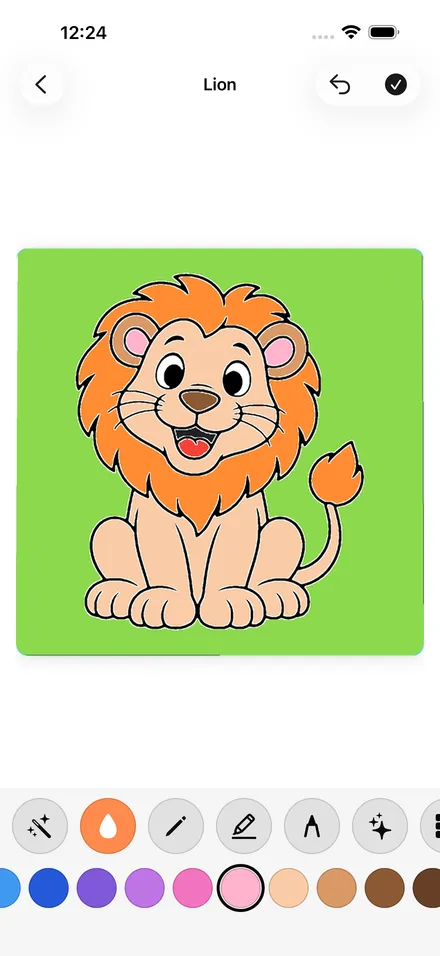
First, young children pick odd colors on purpose all the time. A purple lion is usually imagination. Zero to Three's advice on children's art is to "notice the process, not just the product" (Zero to Three). One unusual picture means nothing. A steady pattern over time is what to mention to a doctor.
Second, you may not see any signs. The NHS says parents may not notice symptoms at all, and the NEI says children who have a color vision deficiency "may try to hide it."
At what age can a child be tested?
From about age 4, according to research reported by the AAO. In a study of 4,005 preschool children aged 3 to 6 in California, researchers found that color vision testing could be done successfully starting at age 4 (AAO, testing children).
The usual test does not need reading. The NEI describes the color plate test: a circle of colored dots with a shape inside, "like a number, a letter, or a squiggly line." A child who has trouble seeing the shape may have a color vision deficiency (NEI, testing). MedlinePlus, from the US National Library of Medicine, adds that small children may be asked to tell a red bottle cap from caps of other colors (MedlinePlus).
The NEI says results come right away. If the first test is not clear, the eye doctor may do others.
For a child younger than 4, you can still raise a concern. The American Academy of Pediatrics (AAP) notes that there are special tests to check a young child's vision even before they can read, and that vision screenings by the pediatrician are an important way to find problems early (AAP).
Is it normal for a 2- or 3-year-old to mix up colors?
Yes. Color names come later than many parents expect, so mistakes at this age usually reflect language, not eyesight.
| Age | Milestone | Source |
|---|---|---|
| 30 months | Shows they know at least one color, like pointing to a red crayon when asked | CDC, 30 months |
| 3 to 4 years | Correctly names some colors | AAP, 3 to 4 years |
| 4 years | Names a few colors of items | CDC, 4 years |
| 4 to 5 years | Correctly names at least four colors | AAP, 4 to 5 years |
So a 2-year-old who calls everything "blue" is on a normal path, and a 3-year-old who swaps red and green is not, by that alone, showing a sign. More on this in when do kids learn colors.
What may be worth a conversation with your doctor: a child past 4 who still cannot name a few colors, a child who mixes up the same pairs again and again while knowing other colors well, or any child with a family history. In those cases the NEI's advice is simple: get their eyes tested.
How common is it in boys and girls?
Much more common in boys. The NEI and AAPOS both say about 1 in 12 men have a color vision deficiency. The AAO puts it at an estimated 1 in 10 males and says women "seldom have the problem."
The reason is genetic. The AAO explains that the inherited form is usually passed from mother to son, and AAPOS describes red-green color blindness as a genetic problem that is more common in men. Mention any family history to the eye doctor.
The California preschool study reported by the AAO found that about 1 in 20 Caucasian boys tested color blind, the highest rate among the four ethnic groups studied, and confirmed a much lower rate in girls than in boys.
Girls can have it too, and the same advice applies.
How can parents and teachers help?
If a color vision deficiency is confirmed, small changes help a lot. AAPOS and the NHS suggest these:
- Tell the school. Teachers can adjust lessons, and the NHS notes schools may be able to adjust exams as well.
- Label crayons, markers and colored pencils with the color name (AAPOS).
- Use black on white for reading. AAPOS says colored paper and colored ink can cause problems.
- Teach the colors of common things. Knowing that grass is green and the sky is blue gives a child a frame of reference when others talk about color (AAPOS).
- Do not rely on color alone. AAPOS notes that people adapt by using other cues, such as brightness or position. At home and in class, add a word, a shape or a number to anything that is color-coded.
- Keep it positive. The AAO article quotes an ophthalmologist: these children are not less bright, "they see the world a little differently." AAPOS notes that early diagnosis can help protect a child's self-esteem in primary school.
Coloring itself needs no change. Let your child choose any colors they like. Pages with clear subjects, such as farm animals or fruits, are a relaxed way to talk about what color things usually are. For group settings, see coloring activities for the preschool classroom.
About special glasses: the NEI says some glasses and contact lenses can help people tell colors apart by increasing contrast, and AAPOS says they work only for certain types. Neither describes them as a cure. Ask your eye doctor before buying anything.
Who does the test?
An eye care professional. Which one depends on where you live.
- In the US, the NEI says to ask your child's eye doctor, and that you may also be able to get your child's eyes tested at school. AAPOS suggests saying at the start of the visit that you are concerned about color vision.
- In the UK, the NHS says color vision testing is not part of the routine NHS eye test, but you can ask an optician for it.
- Elsewhere, ask your child's doctor who tests children's color vision locally.
Online tests and apps are not a substitute. The NHS says that although tests are available online, it is important to get checked by an optician if you have concerns. The ophthalmologist quoted by the AAO says home assessments often give unreliable results. A coloring page or a coloring app is not a test either.
FAQ
Can I test my toddler for color blindness at home?
Not reliably. The sources here advise a professional test, and research suggests testing works from about age 4. Before that, mixing up colors is usually a normal part of learning.
My 3-year-old colored the grass orange. Should I worry?
One picture is not a sign. Young children choose colors for fun. Look for a steady pattern over time, and mention it at the next checkup if it continues.
Is color blindness linked to autism?
None of the sources on this page claim a link. They describe color vision deficiency as an eye condition that usually runs in families.
Does it get worse with age?
The AAO says inherited color blindness usually affects both eyes equally and stays stable through life. A sudden or noticeable change in color vision is different and needs an eye doctor.
Will my child have trouble at school?
The NEI says children may need help with some classroom activities, and most people adjust well. Telling the teacher early is the most useful step.
Sources
- National Eye Institute (US National Institutes of Health), "Color Blindness" (last updated November 5, 2025): https://www.nei.nih.gov/learn-about-eye-health/eye-conditions-and-diseases/color-blindness
- National Eye Institute, "Testing for Color Vision Deficiency": https://www.nei.nih.gov/learn-about-eye-health/eye-conditions-and-diseases/color-blindness/testing-color-blindness
- American Academy of Ophthalmology, "What Is Color Blindness?": https://www.aao.org/eye-health/diseases/what-is-color-blindness
- American Academy of Ophthalmology, "Testing Children for Color Blindness": https://www.aao.org/eye-health/news/testing-children-color-blindness
- American Association for Pediatric Ophthalmology and Strabismus, "Color Blindness" (updated April 2020): https://aapos.org/glossary/color-blindness
- NHS (UK), "Colour vision deficiency (colour blindness)" (page last reviewed March 17, 2023): https://www.nhs.uk/conditions/colour-vision-deficiency/
- MedlinePlus Medical Encyclopedia (US National Library of Medicine), "Color vision test": https://medlineplus.gov/ency/article/003387.htm
- American Academy of Pediatrics, HealthyChildren.org, "Warning Signs of Vision Problems in Infants & Children" (last updated November 11, 2024): https://www.healthychildren.org/English/health-issues/conditions/eyes/Pages/Warning-Signs-of-Vison-Problems-in-Children.aspx
- American Academy of Pediatrics, HealthyChildren.org, "Developmental Milestones: 3 to 4 Year Olds": https://www.healthychildren.org/English/ages-stages/preschool/Pages/Developmental-Milestones-3-to-4-Year-Olds.aspx
- American Academy of Pediatrics, HealthyChildren.org, "Developmental Milestones: 4 to 5 Year Olds": https://www.healthychildren.org/English/ages-stages/preschool/Pages/Developmental-Milestones-4-to-5-Year-Olds.aspx
- CDC, "Milestones by 30 Months": https://www.cdc.gov/act-early/milestones/30-months.html
- CDC, "Milestones by 4 Years": https://www.cdc.gov/act-early/milestones/4-years.html
- Zero to Three, "Learning to Write and Draw": https://www.zerotothree.org/resource/learning-to-write-and-draw/